
You’ve probably seen the word “tokens” thrown around a lot when reading about large language models (LLMs) like ChatGPT. But what exactly are tokens, and why do they matter when it comes to AI? Let’s break it down into simple terms.
So What Are Tokens?
Tokens are the basic building blocks of text used by large language models (LLMs) like ChatGPT, GPT-3, and others. You can think of tokens as the “letters” that make up the “words” and “sentences” that AI systems use to communicate.
Specifically, tokens are the segments of text that are fed into and generated by the machine learning model. These can be individual characters, whole words, parts of words, or even larger chunks of text. For example, the two sentences you literally just read contain 34 words, which is 40 tokens. A helpful rule of thumb is that one token generally corresponds to ~4 characters of text for common English text. This translates to roughly ¾ of a word (so 100 tokens ~= 75 words).
The process of breaking text down into tokens is called tokenization. This allows the AI to analyse and “digest” human language into a form it can understand. Tokens become the data used to train, improve, and run the AI systems.
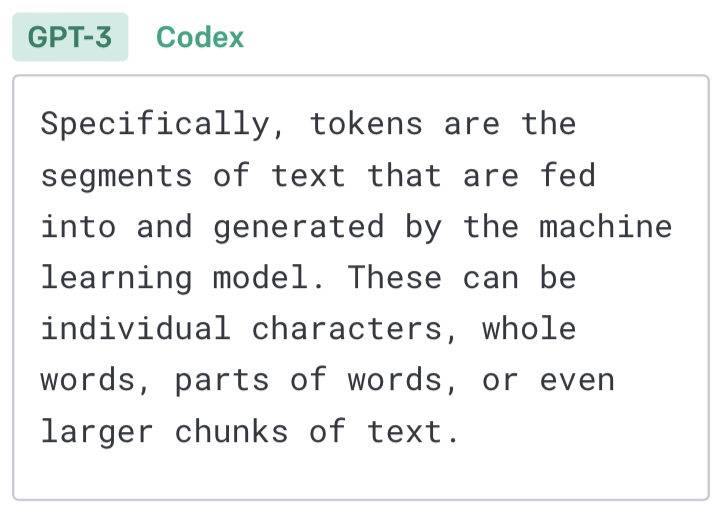
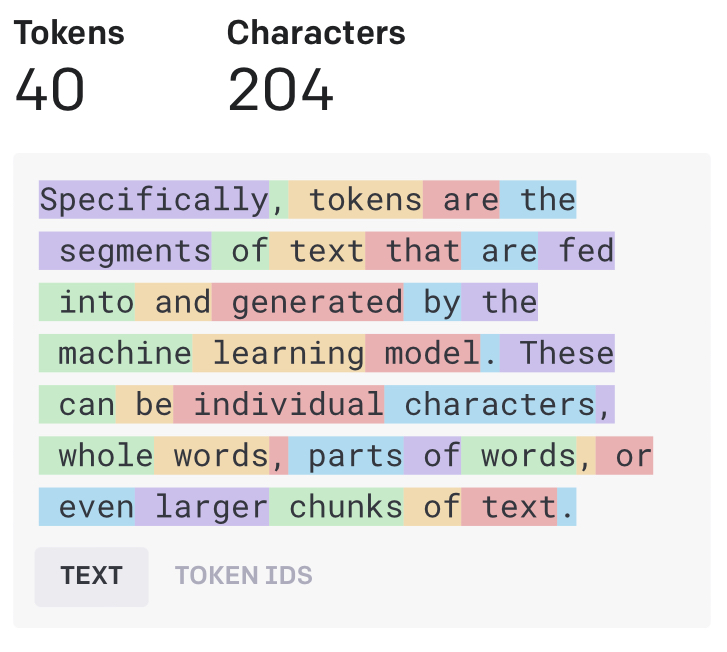
The above images were made using OpenAI’s Tokenizer, you can find it here: OpenAI Platform. It’s a great tool to play with.
Why Do Tokens Matter?
There are two main reasons tokens are important to understand:
- Token Limits: All LLMs have a maximum number of tokens they can handle per input or response. In 2023 this ranged from a few thousand to tens of thousands. By 2026 the picture is very different — frontier APIs now offer roughly 1 million tokens of context (see our 2026 update for the current numbers across GPT-5.5, Claude 4.7, Gemini 3.1 Pro and DeepSeek-V4).
- Cost: Companies like Anthropic, Alphabet and Microsoft charge based on token usage when people access their AI services. Pricing is typically quoted per million tokens, and in 2026 that pricing now splits across input, cached input, output, and reasoning / thinking tokens. Token limits and caching strategies are how you control expenses.
Think of token limits like a friend with limited short-term memory. You have to stay within what they can absorb or they’ll get overloaded and lose track of the conversation. Token limits operate the same way for AI bots.
Strategies for Managing Tokens
Because tokens are central to how LLMs work, it’s important to learn strategies to make the most of them:
- Keep prompts concise and focused on a single topic or question. Don’t overload the AI with tangents.
- Break long conversations into shorter exchanges before hitting token limits.
- Avoid huge blocks of text. Summarise previous parts of a chat before moving on.
- Use a tokenizer tool to count tokens and estimate costs.
- Experiment with different wording to express ideas in fewer tokens.
- For complex requests, try a step-by-step approach vs. cramming everything into one prompt.
While tokens and tokenization may seem complex at first glance, the core ideas are relatively simple. Tokens enable AI bots to converse in human language. Understanding how they work helps avoid common pitfalls and improves your experience. With practice, prompt engineering with tokens becomes second nature.
So the next time you hear “tokens” mentioned alongside ChatGPT or other hot AI trends, you’ll know exactly what it means and why it matters. The token system forms the foundation for translating human communication into machine logic.
Want the up-to-date 2026 picture?
Pricing, context windows, multimodal counting, prompt caching and reasoning tokens have all changed since this article was written. Our refreshed deep-dive covers everything for GPT-5.5, Claude Opus 4.7, Gemini 3.1 Pro and DeepSeek-V4.
Read: What Are LLM Tokens? The Complete 2026 Guide →