The Short Answer
AI can generate rubric-structured feedback for experimental physics lab reports, but mismatches with teacher grading often come from the AI’s ability to retrieve and interpret evidence—especially equations, graphs, tables, units, and uncertainties—not just from model capability.
Practically, this means you can use AI for batch review to draft consistent feedback, then reserve the teacher’s judgment for cases where evidence extraction is uncertain or document elements are hard to interpret.
The key caveat is that PDFs, OCR, and visual/math formatting can limit evidence availability; if the AI can’t reliably read those elements, its feedback may diverge even when the rubric criteria are the same.
On this page
- Introduction
- Why This Matters
- Main Content
- What the Study Found: Agreement Isn’t Just About “Model Quality”
- How Model Evolution Helps—and Why It Still Isn’t the Whole Story
- The Most Common Hidden Problem: Physics Evidence Inside Visuals and Equations
- Two Ways to Use AI: Batch API Processing vs Conversational Review (and Why Hybrid Wins)
- How Teachers Can Get Real Value: Turn AI Output Into “Where to Look,” Not “What Grade to Give”
- Using AI Across Many Reports: Spot Recurring Difficulties and Plan Collective Feedback
- Key Takeaways
AI-Assisted Lab Report Grading That Teachers Can Trust
Introduction
Grading physics lab reports is one of those tasks that feels “simple” until you actually do it: students write pages of text, but the real story lives in the equations, graphs, tables, units, and uncertainties. Now add the hope that AI could help—especially with assessment and feedback—and you get a big, practical question: Can AI really support teachers in experimental physics grading without becoming a black box?
A new research paper revisits an experience using ChatGPT-like models to analyze experimental physics lab reports and digs into what makes these tools helpful—and what can go wrong. The work is based on new findings from “AI-Assisted Assessment of Experimental Physics Laboratory Reports: Potential, Limitations, and Support for Teaching Practice”, and it focuses on something that matters in real teaching: when AI agrees with a teacher, why does it agree? And when it doesn’t, what’s really causing the difference?
The short version is: AI can generate structured, rubric-aligned feedback—but discrepancies often aren’t just about “model intelligence.” They can come from whether the AI can actually retrieve and interpret evidence inside student documents, especially the visual and mathematical parts. And that’s where the teacher’s judgment remains absolutely central.
Why This Matters
This is significant right now because many instructors are already under pressure to grade faster, provide more feedback, and handle larger cohorts—without lowering standards. AI is tempting precisely because it promises consistency and speed. But physics lab reports are not like typical essays: a single missing minus sign, a misread unit, or an unreadable axis label can turn “good work” into “incorrect physics.” So the question shifts from “Is AI smart?” to “Is AI seeing the same evidence I’m seeing?”
Here’s a scenario that could happen today: you’re teaching an experimental physics course where students submit weekly lab reports. You want to (1) quickly spot who needs help with uncertainties and significant figures, and (2) make sure feedback is tied to the rubric—without spending your entire weekend commenting on identical mistakes. A practical use of AI would be to run a batch review across all reports, flagging cases where the feedback depends on hard-to-extract evidence (like graphs or equations). Then you do a focused second look only where it matters.
What makes this research useful (and different from earlier AI-for-feedback work) is the emphasis on a detail that’s often ignored: document processing and evidence availability. The paper connects model evolution (from older text-focused versions to more multimodal and reasoning-capable versions) with the messy reality of PDFs, OCR, charts, and equations. In other words, it builds on prior AI assessment ideas, but it redirects attention to the “plumbing” that determines whether the AI’s output is actually grounded in the student’s work. That’s the kind of insight that prevents wasted effort and avoids turning AI into decorative grading.
Main Content
What the Study Found: Agreement Isn’t Just About “Model Quality”
The original experience the paper revisits (on reaction time and statistics reports) compared instructor grading using a rubric with ChatGPT-generated assessments using equivalent criteria. The goal wasn’t to replace grading, but to see whether AI could support the assessment workflow and help produce rubric-structured feedback.
The study reports two key patterns:
- AI can analyze multiple report components—not just surface-level wording. It can generate structured observations and comments aligned to the rubric.
- Differences appear even when the rubric criteria match, and those differences may not reflect physics misunderstandings alone.
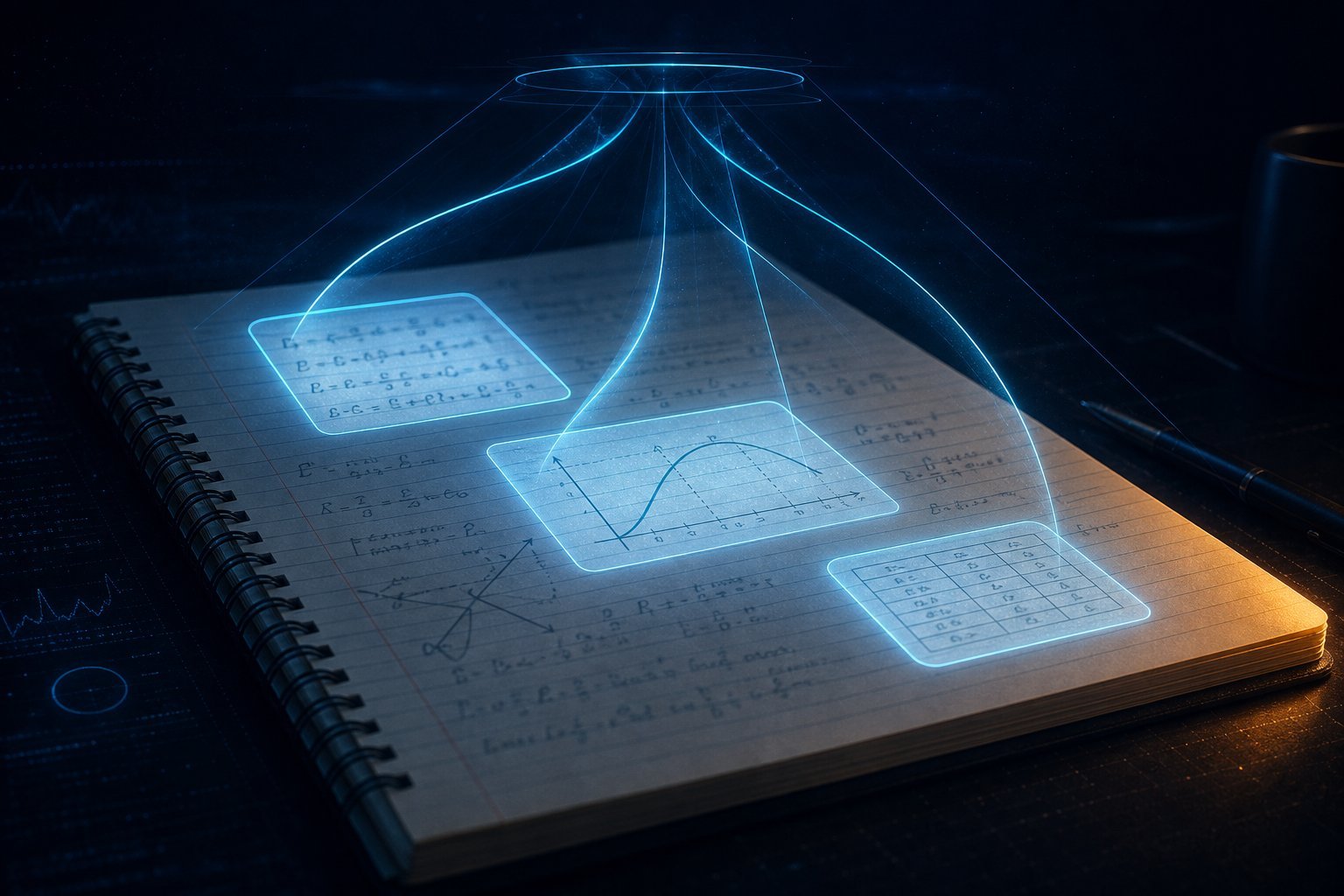
That second point is crucial. The paper argues that discrepancies can arise because AI outputs depend on more than reasoning. They depend on whether the AI can correctly access the evidence in the report. In lab reports, evidence might be present but still effectively “invisible” to the model if it’s embedded in images, graphs, poorly formatted equations, unclear tables, or low-resolution scans.
A helpful analogy: imagine you’re grading a lab where the student wrote everything correctly, but the TA’s flashlight can’t read the thermometer markings because the image is blurred. The TA isn’t “wrong about physics”—they simply can’t see the needed information. AI can run into the same problem.
How Model Evolution Helps—and Why It Still Isn’t the Whole Story
The paper walks through the evolution of models used in the experience, moving from earlier versions like GPT-3.5 toward more advanced reasoning and multimodal options like GPT-4, GPT-4o, and later reasoning-oriented and newer GPT-5.x variants (up to GPT-5.4). The high-level takeaway is that newer models generally improve:
- context understanding,
- reasoning across multiple pieces of information,
- and (with multimodal versions like GPT-4o) joint processing of text and images.
But here’s the catch: stronger reasoning doesn’t guarantee better evidence retrieval. A model can be excellent at interpreting what it can see—and still fail if the document-processing step doesn’t preserve the right content.
Why PDF “Presence” ≠ Evidence “Availability”
The paper highlights a central methodological distinction:
- Evidence may be present in the student’s PDF.
- But that doesn’t mean it becomes available to the model during processing.
The researchers point out practical failure modes during PDF handling and OCR/multimodal processing, including loss or distortion of:
- numbers,
- symbols and signs,
- units,
- equation structure,
- graph labels and legends,
- table formatting,
- and spatial relationships on a page.
So when AI and teacher assessments differ, the cause might be:
- a model capability issue, or
- a document-processing issue that causes extraction errors, or
- both.
Model capability vs. evidence retrieval (comparison)
| Aspect | What newer models improve | What newer models still can’t reliably fix |
|---|---|---|
| Reasoning and consistency checks | Better ability to connect objectives, theory, procedures, results, and conclusions | Cases where the key evidence (equations/axes/units) is not correctly extracted |
| Multimodal understanding (text + images) | More ability to process mixed content like diagrams and figures | Illegible axes, low-resolution charts, tables that OCR scrambles |
| Following complex instructions | More structured outputs and better rubric alignment | “Plausible” responses when the evidence is missing or unreadable |
| Overall usefulness | More types of feedback can be generated automatically | The need for teacher verification when evidence is uncertain |
This is why the paper emphasizes: AI usefulness depends on model capabilities AND the processing conditions that determine what the model actually receives.
The Most Common Hidden Problem: Physics Evidence Inside Visuals and Equations
If you teach experimental physics, you already know what parts tend to break AI workflows: graphs, tables, units, and equations.
The research specifically calls out evidence retrieval difficulties tied to:
- mathematical expressions (and not just plain text equations),
- numerical values and units,
- graphs (axis units, legends, labels),
- data tables,
- experimental diagrams, and
- images included in reports.
Practical analogy: “AI is not a physicist camera operator”
Think of AI like an assistant who can read text quickly, but who sometimes struggles when the “important data” is hidden behind a photo-like layer. If the graph legend is slightly blurred, the assistant may guess what it means. If the equation is an image with tiny symbols, the assistant might misread one character and still produce a coherent-sounding explanation.
And that’s where risk enters: AI can produce feedback that sounds reasonable but isn’t fully supported by evidence.
What the paper recommends teachers and courses do
The guidance is practical and surprisingly specific:
- Ask students to submit high-resolution PDFs, avoiding photos/scans that are blurry.
- Encourage using the word processor’s equation editor rather than inserting equations as images (because embedded image fractions and symbols can be hard to recognize correctly).
- Require graphs to have clearly legible axes, units, and legends within the figure itself.
- When AI feedback is labeled doubtful or invalid, don’t discard the tool—instead, do a second focused check (e.g., conversational review focused on a single criterion).
This is one of the most teacher-useful parts of the paper: it turns “AI might fail” into “here’s how to redesign submissions so AI can reliably access evidence.”
Two Ways to Use AI: Batch API Processing vs Conversational Review (and Why Hybrid Wins)
The paper compares two interaction modes for assessment support:
- API-based batch processing (systematic analysis of many reports at once)
- Conversational interaction (teacher-led dialogue to verify or dig deeper)
Both can be valuable, but they work best for different stages of the workflow.
Comparison of interaction modes
| Mode | Best for | Strength | Limitation |
|---|---|---|---|
API batch processing |
Large cohorts; first-pass rubric review | Consistency across many reports; structured outputs; efficient organization | Less flexible when unexpected issues arise; depends heavily on initial extraction quality |
| Conversational review | Follow-up verification; tricky cases | Teacher can target a criterion and request evidence checks; can re-focus on specific parts | More teacher time and more processing volume per interaction; depends on how questions are asked |
A key insight: costs aren’t just money—they’re also “processing volume”
The paper notes that API processing cost relates to tokens: the amount of input text (including document content) and the amount generated in the response. When you scale to dozens or hundreds of reports, small changes in how much text/feedback you request can add up.
So instruction design matters:
- output length,
- rubric size,
- and how detailed the feedback should be by default.
The hybrid workflow the paper proposes
The most compelling recommendation is not “choose one mode,” but combine them:
- First AI-assisted review (batch / API): process all reports with rubric-aligned feedback.
- Identify cases requiring attention: focus on responses that are superficial, invalid, or hard to justify because evidence is difficult to extract/interpret.
- Focused teacher review (conversational): verify evidence in the original report and, when needed, ask the model to re-check specific elements (a specific equation, table, or figure fragment).
This approach uses AI where it’s strongest (systematic organization) and reserves expert judgment for where correctness depends on detailed evidence interpretation.
How Teachers Can Get Real Value: Turn AI Output Into “Where to Look,” Not “What Grade to Give”
One of the most important messages in the paper is the refusal to oversell AI. AI-generated scores are not interchangeable with teacher grades—even when using the same rubric. So the tool should be treated as an input to guide review, not a final verdict.
Where AI feedback is most reliable
The research implies a difference in reliability depending on the rubric target:
- Criteria that are more descriptive (e.g., “Does the report include X information?”) are often more useful for first-pass review.
- Criteria requiring interpretation of equations, graphs, tables, units, uncertainties, and relationships across results need more careful teacher verification.
A smarter strategy: AI as a “triage system”
Instead of asking the model to decide correctness automatically, the recommended use is to have it help you prioritize:
- Which rubric criteria seem adequately addressed?
- Which aspects show insufficient or unclear evidence?
- Which statements require direct verification in the student report?
- Which assessments might be affected by extraction or interpretation problems?
- Which students/groups show recurring difficulties?
This reframes AI as a workflow assistant: it helps you spend your time on the work that actually requires physics and teaching expertise.
Rubric and prompt design: make evidence citable
The paper offers concrete suggestions to improve reliability:
- Write rubric criteria in observable, verifiable terms.
- In instructions, require the model to support each score with concrete references to the report text (so feedback is evidence-grounded, not generic).
- Use a structured checklist that mirrors what the teaching team would check.
- If the model can’t verify something due to missing legible evidence, ask it to explicitly say so rather than guessing.
This directly targets the failure mode where the AI fills gaps with plausible-sounding content.
Link back to the original paper’s core message
All of these suggestions tie back to the paper’s central idea in https://arxiv.org/abs/2609.22417: differences between AI and teacher assessments can be driven not only by “reasoning ability,” but by whether the evidence in student documents is actually retrievable and interpretable.
Using AI Across Many Reports: Spot Recurring Difficulties and Plan Collective Feedback
Once you have AI reviewing reports at scale, another opportunity appears: pattern detection.
Individual grading helps you see what’s wrong in a given report. But it’s harder to quickly identify what repeats across students. The paper suggests that processing multiple reports together can reveal recurring difficulties such as:
- treatment of uncertainties and significant figures,
- graph construction and interpretation,
- selection and use of physical models,
- units and their role in interpretation,
- description of experimental procedures,
- communication of results,
- and conclusions that don’t properly connect to evidence.
Why this matters pedagogically
This helps instructors distinguish:
- one-off mistakes (likely confusion or oversight),
vs.
- systemic difficulties (likely something needs a targeted teaching intervention).
It can also support collective feedback sessions. For example, if many students struggle with graph reading, you can prepare a common lesson segment using representative examples from the cohort—without needing to reinvent explanations for each individual student.
Important caution: the paper frames this as supporting information for teaching decisions, not an “automatic diagnosis of learning.” Teachers still need to interpret what patterns mean in context.
Key Takeaways
- AI can help grade and comment on lab reports, especially by organizing feedback into rubric-aligned structure—but it’s not a drop-in replacement for teacher judgment.
- Disagreements between AI and teachers often come from evidence access, not just model reasoning: PDFs, OCR, and multimodal interpretation can fail on equations, graphs, tables, and units.
- Document processing is part of the assessment system. “Evidence exists in the PDF” doesn’t mean the model can retrieve it correctly.
- Use a hybrid workflow: batch API processing for first-pass, rubric-structured review across all reports, then conversational, focused verification for cases the AI flags as doubtful or evidence-dependent.
- Design rubrics and prompts for verifiability: require citable evidence, use observable criteria, and instruct the model to admit when it can’t verify due to missing/illegible evidence.
- AI is especially valuable for identifying recurring class-wide difficulties, enabling targeted collective feedback and teaching interventions.
Sources Used
This article is a plain-English breakdown of the following peer-reviewed preprint. Read the original for full methodology and results:
- AI-Assisted Assessment of Experimental Physics Laboratory Reports: Potential, Limitations, and Support for Teaching Practice — arXiv
- Authors: Authors: Marcos Abreu, Cecilia Stari, Arturo C. Marti