The Short Answer
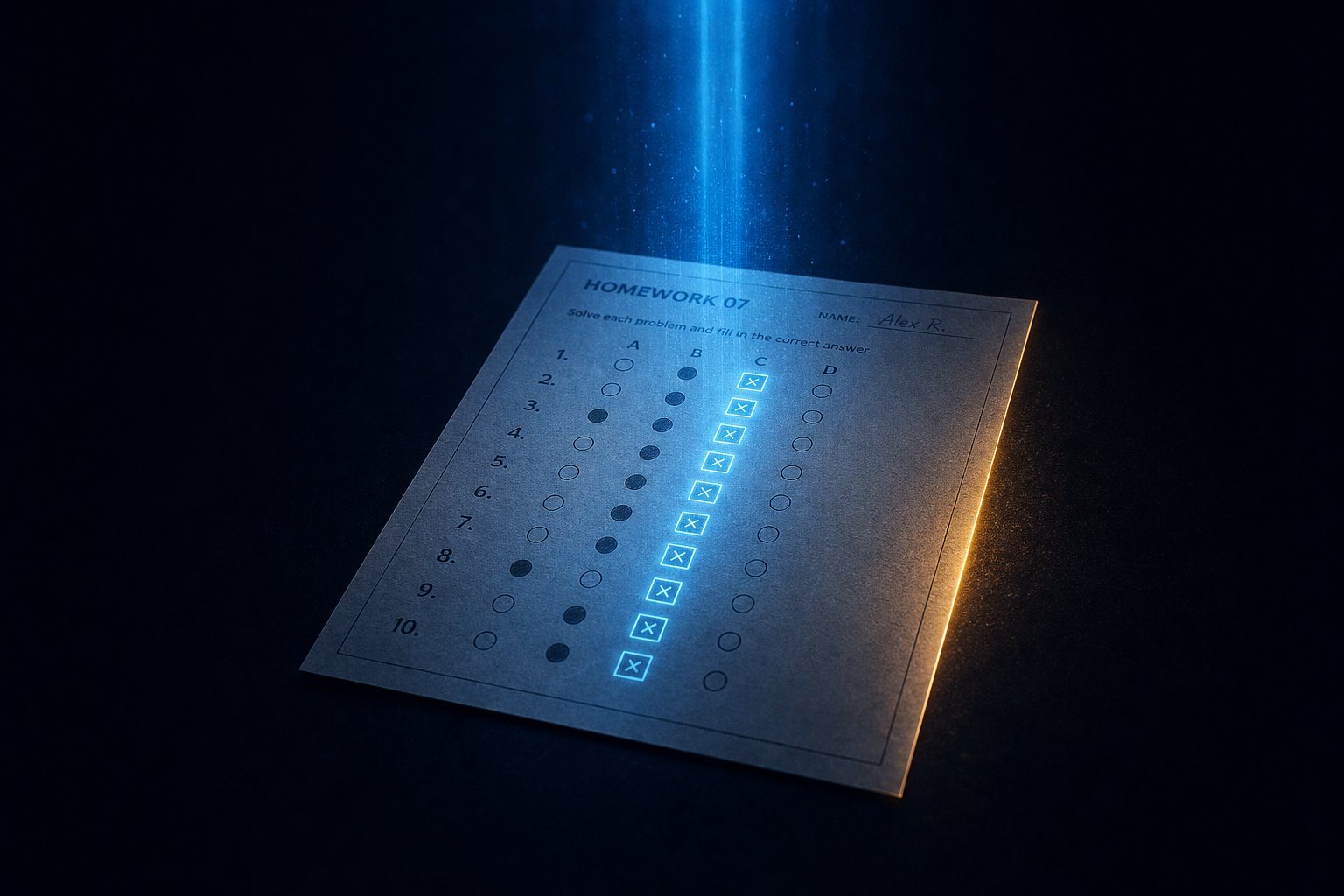
Protected homework can deter AI cheating by embedding “targeted wrongs” into multimodal multiple-choice questions so AI assistants reliably output a specific pattern of incorrect answers. Those wrong answers create a detectable statistical fingerprint for blind copyers.
Instead of trying to judge whether an answer was generated by AI, teachers can test whether a student reproduces the induced wrong-answer pattern more frequently than genuine solvers. This shifts grading toward checking a known statistical signal.
The approach depends on using multimodal questions with visual inputs and on steering patterns that remain consistent under realistic black-box assistant assumptions; it isn’t a generic fix for all homework types.
On this page
- Introduction
- Why This Matters
- How “Protected Homework” Leaves a Statistical Fingerprint
- Turning Black-Box Cheating into Testable Evidence (Without Knowing the AI Internals)
- What They Built: Protected Assignments Across Frontier Assistants
- The Detection Results: High Power With Low False Flags (Under Their Assumptions)
- The Promise and the Limitations of “Fighting Fire with Fire”
- Key Takeaways
AI-cheating can be deterred with “targeted wrongs” in homework
Introduction
Generative AI has made it painfully easy to outsource thinking—students can paste a question into a chat, get a confident-looking answer, and move on. The big catch is that this doesn’t just affect scores; it can erode the actual reasoning practice education is supposed to build. The new research behind this post asks a bold question: what if we could fight AI cheating with something that exploits AI’s own weaknesses?
This blog is based on new work from the original paper (“Fighting Fire with Fire: On the Feasibility of Protecting Exercises Against AI Cheating”). The researchers explore a preventive strategy: instead of trying to detect cheating after the fact, they modify the exercise itself so that AI solvers reliably produce a specific pattern of wrong answers. Then, when students submit responses, the pattern can be detected statistically—like a fingerprint left by blind copying.
Why This Matters
Right now, educators are stuck between two bad options: (1) detectors that often fail once students (or AI workflows) adapt, and (2) redesigning everything, which is slow, expensive, and disruptive. This research matters because it flips the game: rather than asking “Can we catch cheating?” it asks “Can we make cheating leave evidence anyway?” In other words, it tries to raise the risk of cheating without needing perfect detection of every single instance.
A concrete scenario: imagine a school district adopting a standard set of multimodal multiple-choice homework questions—some include images, diagrams, or composite visuals. If the district can apply a protection process during question creation, then students using an AI assistant blindly should start repeating an assistant-driven error pattern across many questions. Meanwhile, honest students—who don’t copy the assistant—won’t show that same pattern. That means the teacher’s workload shifts from “guessing whether writing is AI-generated” to “checking a statistical signal in a known format.”
How does this build on earlier AI research? The approach repurposes ideas from adversarial machine learning, where tiny changes to input can cause models to behave very differently. Past work mainly used adversarial examples as an attack tool (or to show vulnerabilities). More recent defensive systems tried to protect content generation workflows. This paper extends that defensive mindset to education: it uses adversarial perturbations not to break the task for humans, but to steer AI solvers toward controlled wrong answers. The authors explicitly position this as “fighting machine-assisted reasoning with the vulnerabilities of the machines themselves,” and the whole goal is to make cheating less attractive by making it detectably structured.
How “Protected Homework” Leaves a Statistical Fingerprint
The core idea is deceptively simple: if AI assistants are vulnerable to carefully crafted input changes, then we can engineer those changes into homework questions. The trick is to keep the question’s meaning intact for humans while causing AI solvers to answer a particular incorrect option more often than they normally would.
The setting: multimodal multiple-choice with visual inputs
The method focuses on multimodal multiple-choice questions where each question has:
- a textual component,
- a set of answer options,
- and crucially, a visual component (an image the model uses to reason).
Why that matters: visual inputs give a large “continuous” space where small, nearly invisible pixel changes can produce big effects on model predictions—while human perception stays basically the same. The paper notes that this high-dimensional redundancy lets perturbations remain semantically imperceptible to humans but still steer model outputs.
The “targeted wrong answers” mechanism
For each eligible question, the educator (or a system acting on their behalf) chooses a target incorrect option. Then the protected version of the question is built so that an AI assistant is more likely to output that target option.
Think of it like planting a tiny, hidden “guide rail” under a piece of test content:
- For humans, the guide rail is invisible—they see the same image and can reason normally.
- For AI, the rail subtly nudges the model so it falls into a predictable wrong choice.
If a student repeatedly copies the assistant’s outputs, the same incorrect answers will occur more often than chance. That repetition becomes the fingerprint.
Why this isn’t just “breaking the test”
The authors don’t merely aim to reduce AI accuracy in general (which would hurt everyone). Instead, they use targeted adversarial perturbations so that AI failures aren’t random—they’re structured. That structure is what makes later detection possible.
This is also why the paper uses a likelihood-ratio-style detection approach rather than “did the student get something wrong?” Because the signal isn’t raw correctness; it’s whether the student’s wrong answers match the assistant-specific pattern.
(And if you want the official technical framing again, it’s all detailed in the original paper: https://arxiv.org/abs/2608.01112.)
Turning Black-Box Cheating into Testable Evidence (Without Knowing the AI Internals)
A big practical challenge is that educators usually don’t have access to model weights or internals. So this work assumes a black-box assistant setting: the system can be queried, but its internal computation isn’t visible.
The black-box-friendly threat model
The paper’s threat model is specifically about blind reliance:
- The student queries the assistant repeatedly.
- The student does not carefully verify or override errors.
- The student copies the assistant’s chosen options across a substantial part of an assignment.
Students who only use AI for a few isolated questions or who double-check and correct mistakes are less aligned with the attack model, and thus less likely to trigger the detector. So this isn’t “catch every conceivable misuse”—it’s “catch a common pattern of outsourcing.”
How detection works: hypothesis testing on answer patterns
Once the protected assignment is created, the detector looks at the student’s response sequence and computes evidence for two hypotheses:
- H0 (genuine student behavior): the student answers based on their own reasoning.
- H1 (blind copying): the student’s choices match the protected assistant’s induced target pattern.
For each question, the method defines a binary event: did the student pick the target incorrect option? Then it accumulates evidence across questions using a log-likelihood ratio concept.
The key point: the detector requires statistical separation between:
- the probability that a blind-copying student picks the target (driven by the steering),
- and the probability that a genuine student picks the same target by independent chance or reasoning.
The calibration twist: use conservative probabilities
To avoid overclaiming, the authors use careful bounds for these probabilities:
- They estimate assistant behavior by querying the deployed assistant multiple times (the paper uses K=30 calls per protected question–assistant pair during calibration).
- They also rely on educator judgments (multiple researchers) to estimate how likely genuine students are to pick the target option, since that depends on question difficulty and distractor plausibility.
For each question, they keep only those cases where the steering creates enough separation. In the paper’s experiments, that means not every candidate question becomes useful—but the ones that do can reliably support detection.
What They Built: Protected Assignments Across Frontier Assistants
Now to the experimental reality check: the researchers didn’t just run a toy demo on one model. They tested feasibility against multiple frontier multimodal assistants, while constructing assignments using surrogate models.
The assistants tested (and the transfer problem)
The paper evaluates protection against a set of multimodal AI assistants from major families, including:
- Claude Opus 4.8
- Gemini 3 models (including Gemini 3.5 Flash)
- GPT-5 models (including GPT-5.6 Sol and GPT-5.4 variants)
The big question is transfer: can adversarial perturbations optimized against surrogate models transfer to closed-source deployed assistants?
Dataset pool and question selection
They start with a pool of multimodal image-text multiple-choice questions:
- MMMU
- ScienceQA
- MMBench
They selected 100 questions per dataset per model family pool stage (the text states 100 image–text multiple-choice questions each from those three datasets, i.e., 300 total initially). Then, to mimic realistic assessment conditions where assistants can already solve a lot, they reduce the candidate set per assistant:
- only questions the assistant answers correctly before protection are kept.
That means the “denominator” changes across assistants (since some assistants are better on some questions). This is a realistic threat model: in real life, students aren’t attacking an impossible test—they’re attacking an exam the AI can largely pass.
Attack/steering setup in plain terms
For each retained question, they:
1. pick an incorrect target option uniformly from the eligible wrong choices,
2. compute a subtle visual perturbation (bounded by ||δ||_∞ ≤ ε with ε=16 in their sweep),
3. optimize it using an ensemble of six-model surrogate set,
4. then calibrate how often each deployed assistant returns the target after protection.
The optimization uses T=50 attack steps and MI-FGSM-style updates (momentum iterative fast gradient sign method), with random cropping/resizing during optimization so the perturbations don’t overfit to one preprocessing path.
A useful “how consistent is the steering?” comparison
The paper reports how often the protected assistants actually hit the designated target choice, plus how much of the induced error matches the target rather than just causing general failure.
Here’s the qualitative comparison described in the results (dataset-level behavior):
| Dataset | Mean target-response rate | Target share (of induced errors matching the target) | What it suggests |
|---|---|---|---|
MMBench |
8.18% |
93.86% |
Steering is strong and concentrated |
MMMU |
3.57% |
37.00% |
Steering exists but is more variable |
ScienceQA |
1.87% |
47.25% |
Often less steerable because text may dominate |
The authors interpret this as: steering strength depends on both the assistant and the task structure—and sometimes the image-only perturbation has less influence when the question text carries most of the answer.
The Detection Results: High Power With Low False Flags (Under Their Assumptions)
This is the part most people care about: does it actually detect blind copying, and does it accidentally accuse real students too much?
Performance under the educator-provided genuine-student model
The paper assembles a shared assignment of N=20 questions designed to support detection across multiple assistants. They then test detection power and false flags under an educator-guided genuine-student model, with stringent guarantees.
The headline results reported:
- Under the educator-provided student model, the detector achieves at least 95% detection power (i.e., flags at least 95% of modeled blind-copying cases).
- The familywise Type-I error corresponds to fewer than 88 false flags in 10,000 genuine students (under the stated threat model and calibration assumptions).
- With the posterior interpretation:
- for a conservative prior of π=0.01, a flag corresponds to at least 93.0% posterior probability
- for π=0.05, a flag corresponds to at least 98.6% posterior probability
This prior sensitivity matters because the posterior depends on how common blind copying is believed to be in the population. The authors note they use priors based on estimates from prior work (e.g., misconduct prevalence among GenAI users), but their threat model is narrower than “any GenAI use.”
What happens if the genuine-student model is more pessimistic?
The paper also tests a fallback “data-free” genuine behavior model where the probability of a genuine student choosing the target is set more conservatively (they set q̄_i = 0.5 * q̄_i for each question, essentially making it harder to separate genuine from copying).
In that case:
- the familywise Type-I bound increases to about 0.02 (roughly one false flag in fifty genuine cases),
- and posterior lower bounds drop to 31.7% (for π=0.01) and 70.8% (for π=0.05).
So the method’s strictness depends heavily on the educator’s calibration judgments about distractor plausibility.
Transfer to assistants not used during assignment construction
They also test outside their construction set. Their reported outcome:
- the protected assignment transfers well to Gemini 3 Flash,
- but separation is poor for GPT-5.4 and GPT-5.4 Nano (meaning you’d need additional fingerprints or construction for those models to regain strong detection power).
This is important: it’s not “one protected assignment catches every model forever.” It’s closer to “you can build assignments with fingerprints that cover a set of known frontier assistants, and transfer works to some but not all.”
The Promise and the Limitations of “Fighting Fire with Fire”
This paper lands in an interesting middle ground: it’s not a magic anti-cheating spell, but it’s a real proof that a preventive, statistically grounded approach can work—at least under specific conditions.
Why the approach is promising
- It turns AI weakness into an audit trail. The perturbations create a detectable pattern when copied blindly.
- It can handle black-box models using query-based calibration—no weight access needed.
- It supports multi-assistant coverage: the shared assignment can support fingerprint detection across
Claude,Gemini, andGPTfamilies (within the tested coverage set).
Where it can fail (and why that’s not just “bad luck”)
The authors explicitly list assumptions that drive feasibility:
- assistants remain stable in their behavior,
- student responses are sufficiently independent and repeated copying is consistent,
- students truly copy blindly rather than verifying.
Also, the method relies on educator-controlled calibration. If educators can’t reliably bound genuine behavior probabilities for target choices, false-flag risk rises and posterior certainty drops.
Finally, steering transfer isn’t guaranteed. The fact that the assignment performs poorly on some assistants outside the construction set shows that fingerprints may need model-specific tuning over time.
A practical implication: the “assessment design” workload shifts, not disappears
This isn’t “press a button and forget it.” But it suggests a new workflow:
- build protected versions during question design,
- calibrate carefully,
- maintain fingerprints as models evolve.
If educators treat it like assessment engineering—similar to how we think about rubric design, distractor quality, and fairness—this could become a manageable part of modern test creation rather than a desperate end-of-semester detective job.
Key Takeaways
- The method protects AI-reliant cheating before submission by using subtle visual perturbations in multimodal multiple-choice questions.
- Instead of merely lowering AI accuracy, it steers AI solvers toward designated incorrect targets, creating a repeated answer fingerprint.
- Using black-box querying plus statistical hypothesis testing, the paper reports at least
95%detection power for modeled blind copying, with fewer than88false flags in10,000genuine students under the educator-calibrated model. - Steering effectiveness varies by dataset:
MMBenchshowed strong targeting (8.18%target response rate with93.86%target share), whileScienceQAwas weaker (1.87%rate). - Transfer is partial: strong results were reported for assistants covered during construction, with mixed performance for some outside models (e.g., poor separation reported for certain
GPT-5.4variants). - The real-world strength depends on educator judgment and calibration—because the detector’s false-positive guarantees rely on modeling genuine-student target-selection probabilities.
If you want, I can also rewrite this as a “teacher-friendly” checklist (what you’d need to build, calibrate, and maintain) or explore ethical considerations: how to ensure this doesn’t punish legitimate students, and how to keep assessment integrity fair as AI systems evolve.
Sources Used
This article is a plain-English breakdown of the following peer-reviewed preprint. Read the original for full methodology and results:
- Fighting Fire with Fire: On the Feasibility of Protecting Exercises Against AI Cheating — arXiv
- Authors: Authors: Tobias Braun, Jonas Grebe, Louis Rethfeld, Marcus Rohrbach

