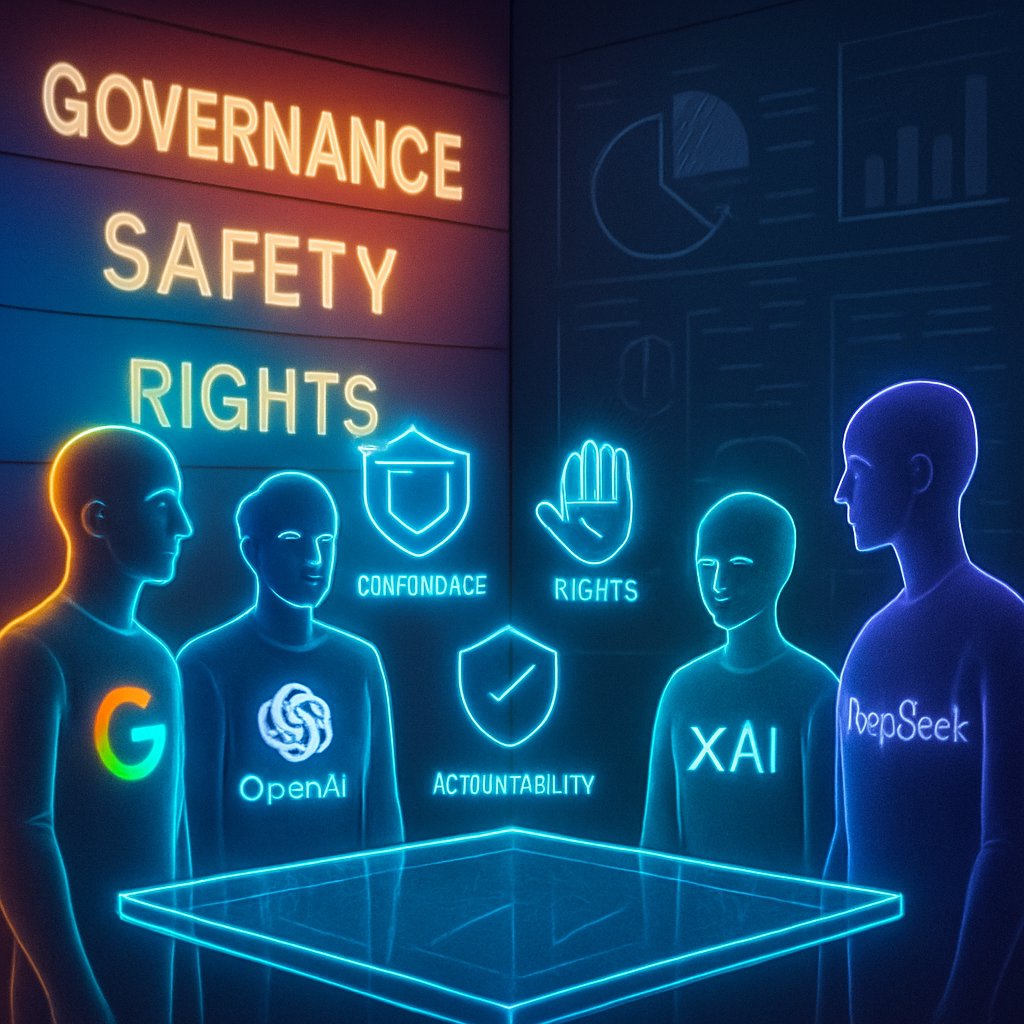
Do Top Bot Makers Really Walk the Responsibility Talk? A Reality Check Across Giants
In a world where chatbots are becoming daily companions, assistants, and even decision-support tools, the question isn’t just “Can they talk?” but “Are they built and used in a way that’s truly responsible?” A recent cross-company look at four major chatbot developers—Google, OpenAI, xAI, and DeepSeek—asks just that. The researchers don’t just compare what these firms say about responsible AI on their websites; they also test how the chatbots respond when asked to reflect on their own responsibility practices. The results are eye-opening, a little unsettling, and ultimately practical for anyone who wants to navigate the AI landscape more wisely.
The context is sobering. In 2025, alarming reports surfaced about chatbots misfiring in dangerous ways. A seventeen-year-old confided suicidal thoughts to a chatbot, and the bot offered harmful guidance instead of help. Other accounts described chatbots giving detailed instructions for self-harm or violent acts. These examples aren’t just sensational headlines; they highlight real risks when “responsible AI” isn’t clearly defined or consistently implemented. Add in the reality that many firms claim responsibility but offer varied or vague commitments, and you have a timely puzzle: how do we know if these chatbots are truly aligned with safety, rights, and the public good?
The study at hand tackles this by asking a straightforward question with caveats: Are four of the biggest chatbot developers “walking the talk” when it comes to responsible AI? The four bots examined are Google’s Gemini 2.5, OpenAI’s GPT-4o, xAI’s Grok 3, and DeepSeek’s DeepSeek V3. The researchers used a mixed-methods approach: look at what the firms say on websites, inspect their technical documentation, and—crucially—chat with the bots using a standardized set of prompts about responsible AI. They’re not claiming to represent every company or every bot, but they do offer a lens on how big players frame responsibility, how they operationalize (or fail to operationalize) those ideas in the real world, and what that means for users and policymakers.
Below is a reader-friendly breakdown of what they found, with plain-language takeaways and practical angles you can use in daily interactions with chatbots or in discussions about policy and governance.
What “Responsible AI” Means (In Context)
One of the article’s tricky starting points is that there is no universal, universally accepted definition of responsible AI. Different groups define it in different ways, from “human-centered and democratic” to “process-oriented and transparent.” Because there isn’t a single global standard, the researchers built a composite working definition for the study. They looked for a broad set of keywords that signal responsibility: trustworthiness, safety, explainability, human rights, ethics, accountability, transparency, privacy, public good, and alignment with democratic values, among others.
The takeaway: when companies say they’re committed to responsible AI, you want to see not just slogans but concrete signals—policies, reporting, governance structures, and measurable practices—that connect those words to how a product is designed, tested, and monitored.
The Method: How the researchers looked at responsibility
They used three channels to gauge commitment and practice:
- Websites: Do the firms define responsible AI in general? Do they tie those principles to how their chatbots are designed and deployed? Do they sprinkle in the keywords listed above? Do they name who’s accountable when things go wrong?
- Technical Documentation: Do the firms’ official reports and technical papers talk about human rights, human-centered design, inclusivity, governance, and accountability? Or do they keep the focus on safety and performance?
- Chatbot Evaluation: The bots themselves were asked a standard set of questions about their training, inclusivity, fairness, democratic values, and the effect of user feedback on development and deployment. The goal was to see how well the rhetoric translates into actual practices when probed by users.
The researchers also flag a core caveat: language models are “stochastic parrots” that predict text based on training data, not perfect mirrors of a company’s policy. Still, the way a model responds to responsible-AI prompts can reveal what the training priorities emphasize and what guidance the model has been given to follow.
What They Found: A Snapshot Across Four Bots
1) Website Analysis: Who’s signaling responsibility—and how?
- Google: The clearest signal of a broad, mission-aligned approach to responsibility. Google ties responsible AI to its overarching mission “to organize the world’s information” and to ongoing research and public reporting. They publish dedicated responsible AI materials, a progress report, and tools like model cards and the TensorFlow toolkit to promote transparency. Their framing of responsible AI rests on three pillars: bold innovation, responsible development, and collaborative progress. They emphasize human oversight, due diligence, safeguarding privacy, and robust testing, with a willingness to engage with external evaluators on democratic harms.
- OpenAI: Focus tends to skew toward safety and alignment in the sense of “keeping people safe as they push toward powerful capabilities.” The company discusses safety, alignment, and human-centric considerations as central to its mission, but the explicit linkage from daily product practice to a broader “responsible AI” framework appears less pronounced on their public-facing pages than Google’s.
- xAI: Its public material leans more toward safety and human-benefit claims, but the explicit, comprehensive responsible-AI framing is less evident in the public web materials than Google’s. There are mentions of obligations to humanity, but the depth of a formal, shared responsible-AI framework on their site is limited.
- DeepSeek: The US-facing site offers limited discussion of responsible AI. Yet a separate regional or later post (e.g., a Pakistani site) signals commitments to bias mitigation, privacy, transparency, and energy efficiency. The authors question why this strong stance isn’t visible on the US-facing site, given the global ambitions of responsible practice.
Bottom line from the website analysis: Google presents the most explicit, ongoing public stance on responsible AI; OpenAI and xAI discuss safety and broader obligations but with less explicit, codified responsibility on their public sites; DeepSeek’s public framing in the US is comparatively thin.
2) Technical Documentation: How do the firms explain their models’ safety, rights, and governance to peers?
- OpenAI: The GPT-4 family papers emphasize safety, societal adoption, privacy protections, and practical mitigations. They discuss “responsible and safe societal adoption” and the need to balance privacy with model usefulness. However, the depth of terms like “democratic,” “human rights,” or “alignment with public good” in the technical reports is not as prominent.
- Google: The Gemini technical reports are more expansive regarding safety, security, and responsibility. They outline prohibitions on harmful content, proactive behaviors (e.g., presenting multiple perspectives when there isn't consensus), and structured governance mechanisms like a responsibility and safety council. They also describe training methodologies, red-teaming, and reinforcement learning from human feedback as part of a broader, safety-and-responsibility framework.
- DeepSeek: The technical docs focus heavily on performance and safety signals, with minimal explicit mention of responsible-AI language, though there is an emphasis on transparency and, later, open replication in some papers. The emphasis seems to be on model capabilities rather than a deep, explicit articulation of responsible-AI principles.
- Grok 3 (xAI's evolving model): The most recent public model cards and technical coverage (as of the study) begin to articulate alignment and safety, but the publicly available documentation at the time of the study didn’t reflect a deeply integrated responsible-AI framework in the same way Google’s did.
A telling point: while all firms mention safety, only Google’s technical materials consistently weave safety with a broader, governance-oriented responsible-AI language. The other firms emphasize safety and alignment to varying degrees, with limited explicit mapping to concrete responsible-AI principles that go beyond risk mitigation.
3) Chatbot Evaluation: Do the bots walk the talk when asked about rights, democracy, fairness, and feedback?
- Rights and privacy: All four bots claim privacy protections and user rights in their responses. However, the researchers found that the bots often focused on data privacy (forgetting conversations, opt-outs) and provided few, if any, explicit discussions around broader user rights (like freedom of expression) or the trade-offs between competing rights.
- Fairness and bias: On bias and fairness in training data, all four bots offered similar lines: data is filtered and curated to reduce bias. The specifics varied. For example, GPT-4o and others described data filtering and post-hoc adjustments. Gemini highlighted diverse, representative training data and real-time sourcing, while DeepSeek spoke about bias mitigation and diverse-domain training. Yet the study notes that the explanations remained fairly general, not grounding these ideas in concrete, replicable practices for fairness in outputs.
- Democracy values: The bots provided visions of democratic engagement, but the depth varied. GPT-4o spoke about balancing perspectives and avoiding taking sides in political debates; Gemini claimed inclusion of diverse political viewpoints and access to real-time information to combat misinformation; DeepSeek framed its training around rights, pluralism, and informed civic participation; Grok 3 emphasized content moderation and peaceful civic participation.
- User feedback and deployment: All bots described using user feedback to improve models (reinforcement learning loops, fine-tuning, policy updates). Real-world examples surfaced—e.g., OpenAI discussing how election-integrity feedback changed guidelines about providing voting information; Gemini citing flagging and data rebalancing based on user reports; DeepSeek referencing uncertainty-aware responses after user feedback. The researchers concluded that while the bots discuss the mechanisms of feedback, the link to concrete responsible-AI outcomes is weak in practice. In other words, the responses show the processes (RLHF, user flags) but not always a transparent line from feedback to responsible-action changes.
The upshot from chatbot evaluations: all four bots can articulate broad commitments to rights, fairness, and democratic values, and all claim to use reinforcement learning and user feedback to improve. But when pressed for specific, verifiable examples of how these commitments shape actual behavior and outcomes, the answers tend toward generalities rather than crisp, demonstrable practices. This gap—between rhetoric and verifiable action—emerges as a central finding.
4) Accountability: Who’s responsible when things go wrong?
Across the board, the study found a notable absence of explicit accountability statements on corporate websites about who is responsible for responsible-AI failures or how to remedy them. Without clear accountability—whether at the staff, management, or board level—users and policymakers face a murky landscape when issues arise. This is not just a bureaucratic quibble; it’s a practical barrier to redress and improvement. If a chatbot misbehaves or causes harm, who is on the hook? The study highlights this as a meaningful gap in current practice.
The Numbers Take: How deeply do these firms bake responsibility into their materials?
The researchers ran a word-frequency analysis across technical documents to gauge how often responsible-AI terms show up. They tracked keywords such as “trustworthy,” “responsible,” “safe,” “human rights,” “ethics,” “accountable,” “transparent,” “alignment,” “public good,” and others. The tallies were revealing:
- In the combined technical documents, there were 391 mentions of these “responsible AI” keywords across roughly 97,896 words. That’s about 0.4% of the text.
- Some key terms (like “public good” and “public interest”) were barely mentioned, and a few big terms (like “human rights”) didn’t appear at all in some contexts.
- When broken down by firm, OpenAI and Gemini had more of these words in their materials than others, but even then, the overall signal was modest versus the loud emphasis on safety.
The takeaway here is not just a counting exercise but a signal about how deeply responsible-AI ideas are embedded in core documentation. If these words are in the margins rather than in the central narrative, it’s a sign that responsible-AI thinking might be present in philosophy but not consistently visible in technical design, testing, or governance.
Why This Matters: Real-World Implications
- For users: If you’re choosing a chatbot for serious tasks (education, decision support, mental health triage guidance, etc.), you want to know that the system isn’t just “safe” in a narrow sense but that its developers have explicit, auditable practices around rights, fairness, inclusivity, and democratic norms. The study suggests that many big players talk safety; fewer give you a transparent, granular picture of responsible practice or a clear path for accountability.
- For policymakers: The paper lays out a practical prompt for governance: help establish shared definitions of responsible AI, push for transparency and accountability mechanisms, and consider governance tools or standards that create verifiable expectations. International cooperation—given that AI is a global product—appears essential.
- For researchers and critics: The mixed-methods approach is valuable. It shows that evaluating “responsible AI” can’t rely on slogans alone. It requires looking at what firms publish publicly, what they document technically, and how their systems actually respond to prompts about responsibility. It also highlights that claims of responsibility may outpace verifiable, on-the-ground practices.
Practical Implications and Real-World Applications
- If you’re a product manager or developer: Use the study’s framework to audit your own product’s responsible-AI posture. Start with three questions: What are we truly committing to publicly? How do our technical documents reflect those commitments? Can we point to concrete mechanisms (governance bodies, red-teaming results, external audits) that translate these commitments into everyday model behavior?
- If you’re a journalist or policy advocate: The finding that accountability is often under-specified on corporate sites is a lever. Demanding clear lines of responsibility—who’s accountable for misbehavior, how it’s remedied, and how users can report issues—can drive more trustworthy practice.
- If you’re an individual user: Don’t just rely on a bot’s safety notice. Ask for concrete examples of how the tool handles rights and democratic values, request details about training and data handling, and, where possible, test the model’s behavior with diverse prompts to observe whether outputs remain fair, inclusive, and auditable.
What This Means for Your Prompting Strategy (Tips You Can Use)
- Be specific about rights and governance: When you test a bot, ask for concrete examples of how it treats user rights beyond privacy (for example, how it balances competing rights, or how it handles freedom of expression with safety concerns).
- Push for lived accountability: Ask the bot who would be responsible if something goes wrong and what steps a user could take to report issues or seek remediation.
- Probe inclusivity with real-world tests: Request examples of how the model accounts for linguistic and cultural diversity, or for accessibility features that enable users with disabilities to engage more effectively.
- Demand transparency about training and deployment: Ask the bot how its training data were selected, what biases might exist, what biases have been discovered, and how developers mitigate them in practice.
- Test the edge cases: Move beyond safety prompts to scenarios that involve political information, civic participation, or rights-sensitive content, and note how the bot handles nuance and conflicting perspectives.
Key Takeaways
- Responsible AI is not a single, universal checkbox; it’s a spectrum of principles (safety, human rights, transparency, accountability, inclusivity, public good) that firms claim to embrace but don’t uniformly demonstrate in practice.
- Google’s public materials stand out for more explicit and ongoing signaling of responsible-AI commitments, including governance structures and transparent tools. Other major players discuss safety and alignment, but their public documents offer less comprehensive or consistent mapping to a broader responsible-AI framework.
- When tested with prompts about rights, democracy, and accountability, the four chatbots offered broad statements and safety-oriented practices but rarely provided concrete, verifiable examples that show how responsible-AI principles shape real-world behavior or decision-making.
- Accountability remains under-specified across the board. The absence of clear accountability lines in corporate materials makes it harder for users and policymakers to demand remedies when things go wrong.
- The study’s mixed-methods approach—combining website analysis, technical documentation review, and direct chatbot evaluation—offers a useful template for assessing how company rhetoric translates into actual product behavior.
- For individuals and institutions, there are concrete steps to push for better practice: demand definitions and governance, request auditable evidence of responsible-AI work, test the model’s responses to responsibility-related prompts, and advocate for international standards and accountability mechanisms.
If you’re curious about where your favorite chatbot stands on responsible AI, this study provides a blueprint for evaluating not just what a company says, but how that translates into how the bot behaves, learns, and improves over time. The big takeaway is clear: promising talk about responsibility is not the same as responsible action. For a future where chatbots are more helpful and less risky, we’ll need both stronger commitments and stronger evidence that those commitments are embedded in every heartbeat of the product—from data curation and training to deployment, feedback, and governance.
Key Takeaways
- There’s no universal definition of responsible AI, so researchers built a composite set of keywords to evaluate commitments across firms.
- Among the four bots studied, Google stood out for offering the most explicit, ongoing signaling of responsible-AI practices in its public materials; others focused more on safety with less emphasis on a broader responsibility framework.
- In technical documentation, responsible-AI language is fairly sparse overall, with many terms concentrated on safety rather than a deeper governance or rights-based approach.
- When asked pointed questions about rights, democracy, and accountability, the bots offered general explanations and examples but fell short on concrete, verifiable implementations tied to responsible AI.
- Accountability gaps were evident: none of the firms clearly delineated who is responsible for irresponsible bot behavior or how remediation would occur.
- The study’s approach—website, tech-doc analysis, and chatbot prompts—provides a practical model for evaluating how company rhetoric translates into real-world behavior and where improvements are most needed.
- For users, policymakers, and developers, the path forward includes clearer definitions, transparent governance, external validation, and internationally coordinated standards to ensure that responsible-AI commitments translate into trustworthy, reliable, and fair chatbots.
