The Short Answer
A new paper constructs a smooth random fast dynamo on the 3D torus and proves a uniform-in-time, almost-sure exponential lower bound on magnetic field growth for all sufficiently small resistivity. The growth rate is at least about 1/2^{1/21/2} in the paper’s formulation.
So what: if your model uses incompressible random velocity fields that refresh in time blocks, you can get reliable exponential amplification that persists in the low-resistivity regime rather than dying out.
Caveat: the theorem is conditional on the specific random velocity construction and the exceptional null set may depend on the resistivity value.
On this page
- Introduction
- Why This Matters
- A random velocity field engineered to amplify magnetic modes
- What the induction equation looks like when you stare at it in Fourier space
- How the proof becomes a recursion you can actually iterate
- Putting it together: the fast growth statement for small resistivity
- AI as a collaborator: from generated proof ideas to a verified human rewrite
- Key Takeaways
Fast random dynamos on the 3D torus—AI-built proof
Introduction
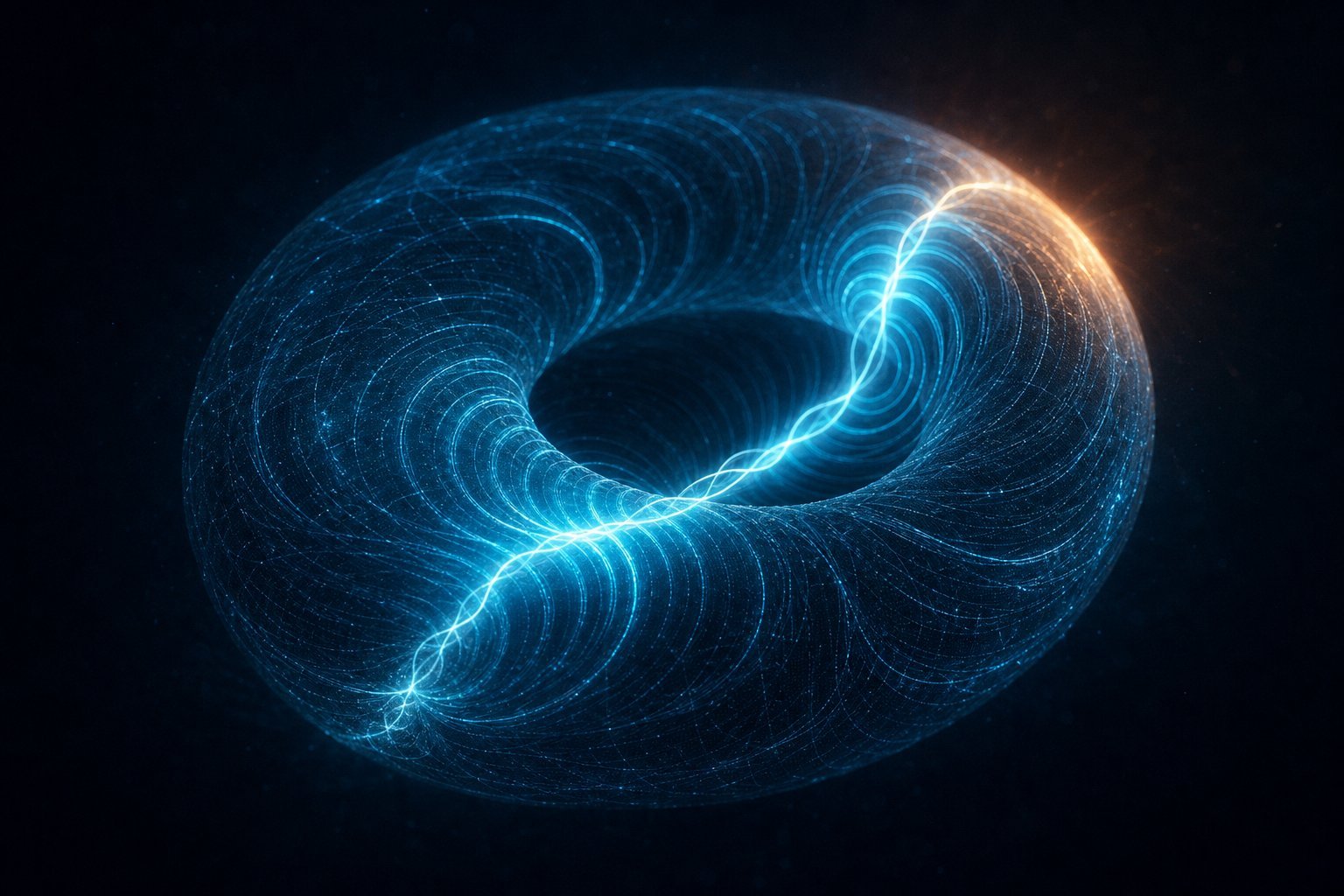
If you’ve ever wondered how magnetic fields can keep growing inside a moving conducting fluid—even when resistivity is present—this new paper is a pretty striking answer. It constructs an AI-discovered smooth random fast dynamo on the flat 3D space (\mathbb{T}^3). In dynamo language: the paper builds a specific kind of (divergence-free) random, time-dependent velocity field that forces solutions of the resistive induction equation to grow exponentially fast.
What makes it especially interesting is that this is not just “growth sometimes” or “growth in a limit.” The main theorem gives a uniform-in-time lower bound on exponential growth (with a random prefactor), and it works for all sufficiently small resistivity. The growth rate is bounded below by a positive constant—explicitly, at least (1/2^{1/21/2}) in the paper’s formulation (i.e., the almost-sure exponential growth rate stays (\ge 1/2) for small enough resistivity). The full result and proof are in the original paper, by Keefer Rowan.
And yes—there’s an AI angle that goes beyond hype. The core proof idea was generated autonomously by ChatGPT 5.6 Sol Ultra, then rewritten and carefully verified by the author. The manuscript even explains how the initial AI-generated approach had issues (including a different setup and a more complicated backward-in-time argument), and how the final proof was reconstructed to be simpler and cleaner.
Why This Matters
This is significant right now because the “fast dynamo on smooth data” story has been slowly tightening around a key open end: we want dynamo examples that are (1) physically natural, (2) on flat compact spaces like (\mathbb{T}^3), and (3) smooth in space, not just Lipschitz or carefully tuned regularity. Until recently, many rigorous constructions achieved fast dynamo behavior in settings or with regularity that felt a bit off from what you’d want as a realistic model.
A concrete scenario where this matters today: think about turbulent flows in a conducting medium where you can model the velocity as a superposition of Fourier modes with some randomness—random phases, random switching, or blockwise refresh. Even if real fluids aren’t literally on (\mathbb{T}^3), the mechanism is the same: you’re trying to prevent systematic cancellations that would otherwise stop growth. This paper shows, in a clean mathematical model, that carefully designed randomness can reliably promote growth rather than merely “add noise.”
How this compares to previous AI-linked research is subtle. The paper points to recent uniform-in-diffusivity exponential mixing results (in particular references like [BBPS21, CIRS25]) as an analogue: there, randomness prevents worst-case cancellations and yields robust quantitative behavior. Here, the author builds a dynamo analogue, but the mechanism is more algebraic than probabilistic: it exploits a special Fourier-space structure that turns an infinite-dimensional dynamo problem into something that behaves like an iterative recursion on a few modes.
A random velocity field engineered to amplify magnetic modes
What “fast dynamo” means in this paper’s setting
The core object is the resistive induction equation, which (schematically) evolves a divergence-free magnetic field (b^\kappa(t,x)) under an incompressible velocity field (u(t,x)), with resistivity (diffusion) parameter (\kappa\ge 0). The paper studies the growth rate
[
\gamma(u,\kappa)
]
defined from the long-time exponential behavior of (\|b^\kappa(t)\|) (via a logarithmic growth rate in time).
A fast dynamo is one where this growth rate stays bounded below by a positive constant uniformly as (\kappa) becomes small—so growth doesn’t “die” in the ideal (low-resistivity) limit. In the deterministic world, you want (\gamma(u,\kappa)\ge \gamma_0>0) for every small (\kappa). In the random world, you instead get an almost-sure statement: for each fixed (\kappa), the exceptional probability-zero event depends on (\kappa).
This work gives a particularly strong version: not only exponential growth almost surely, but also a time-uniform lower bound with a random prefactor.
The kind of randomness used: iid phases in Fourier space
The paper constructs a random velocity field (U(t,x)) on (\mathbb{T}^3) in a blockwise manner: it uses independent random choices (iid) over finite time blocks, and the randomness is tied to independent random variables (\thetaj) (with (\thetaj) uniformly distributed in (\mathbb{T}^3)-valued space). The velocity is built using a smooth bump function (\eta) supported on ([0,1]) (scaled so its integral is 1), so the velocity is smooth in time and space, not just a piecewise-constant cartoon.
Crucially: the velocity field is divergence-free ((\nabla\cdot U=0)), matching incompressible flow assumptions and ensuring the divergence-free condition for the magnetic field propagates automatically.
Why smoothness and compactness are not just cosmetic
The torus (\mathbb{T}^3) is a flat, compact 3D manifold. Compactness matters because physical “growth localizes” in real spaces, and dynamo action is often discussed on compact domains for mathematical and physical relevance. Smoothness matters because many earlier results on flat spaces achieved the desired behavior at Lipschitz regularity—often a “critical” threshold—while physically you’d prefer smooth flows.
This paper claims the first smooth random fast dynamo in this specific flat torus setting, building on a recent cluster of fast dynamo results on (\mathbb{T}^3) (including limsup-liminf variants and constructions at or near Lipschitz regularity) and complementing earlier smooth dynamo work that either produced slow dynamos or only fast dynamos along sequences of resistivities.
What the induction equation looks like when you stare at it in Fourier space
The Fourier-mode viewpoint: turning PDE growth into mode amplification
The dynamo equation is a PDE, but in (\mathbb{T}^3) it admits a Fourier series description. Each Fourier mode corresponds to an integer wavevector (k\in\mathbb{Z}^3). The paper’s key move is to stop treating the evolution as a mysterious operator acting on infinitely many modes, and instead identify a finite algebraic skeleton inside the operator.
The solution operator over one unit time—call it (\mathcal{T})—maps the Fourier coefficients of the magnetic field forward in time. Under translations in the velocity (random shifts), the operator gains a structured dependence on the random translation parameter. This is the backbone of earlier translation-based dynamo constructions, including work like [Row25] mentioned in the paper.
The “translation trick” and where naive randomness can fail
A tempting thought is: “If some Fourier coefficient grows for some choice of randomness, then typically it will grow for typical randomness.” The paper explains why that’s generally false. A distribution could concentrate mass on a set of translation parameters (\theta) that produce large coefficients, while most other (\theta)’s yield cancellations and small coefficients.
So the problem isn’t merely to show growth occurs along some noise trajectory. The challenge is to show growth happens almost surely (or in a time-uniform way) in a robust manner.
The structural innovation: a tridiagonal action on chosen modes
The main innovation is an algebraic one in Fourier space. The induction equation solution operator (\mathcal{T}) is engineered (by choosing the velocity field’s Fourier structure) so that, when restricted to carefully chosen families of modes, it behaves like a tridiagonal matrix on certain “rows” of coefficients—rather than a fully dense infinite interaction.
Informally: most modes don’t talk to each other chaotically. Instead, in the right coordinates, the evolution of a small set of key coefficients depends mainly on a neighbor-like pattern: each step feeds into the next few steps in a controlled way.
This is the kind of situation where you can replace “hard infinite-dimensional dynamics” with “manageable recursion,” which is exactly what the paper does.
How the proof becomes a recursion you can actually iterate
Tracking three special Fourier modes
The paper’s argument propagates expected growth of the logarithmic size of three specially chosen Fourier modes. Instead of trying to bound the whole magnetic field norm directly (which would force you to control complicated interactions across infinitely many scales), it focuses on a small set of “witness modes” whose growth implies growth of the overall energy.
You can think of these modes as “amplifier channels.” If their amplitudes keep getting kicked upward, the whole system can’t stay small.
A Jensen’s formula lemma for polynomials on the unit circle
Once you isolate those three modes, the translation parameter enters through a complex exponential (e^{2\pi i\varphi}). The paper then reduces relevant coefficient magnitudes to expressions of the form
[
\left|a e^{-2\pi i\varphi} + b + c e^{2\pi i\varphi}\right|,
]
which is the magnitude of a degree-2 polynomial on the unit circle.
At this point the proof uses a specialized consequence of Jensen’s formula—a complex analysis tool—giving a lower bound on the average of (\log) magnitudes of such polynomials in terms of the coefficients (specifically in terms of “extremal coefficients,” i.e. the lowest/highest degree coefficients rather than the middle one alone).
This is where the tridiagonal structure becomes essential: if the polynomial involved too many degrees or intermediate terms dominated, the neat extremal-coefficient control would break down.
From expected log-growth to almost-sure, all-time lower bounds
The paper doesn’t stop at an “in expectation” statement. It uses a further martingale-style argument (again leveraging the special polynomial structure) to show that fluctuations around the expected growth cannot overwhelm the trend.
The result is strong: a time-uniform lower bound on the growth rate for all (t\ge 0), not just along a subsequence of times. There is a random constant (L^\kappa\ge 1) that depends on the resistivity (\kappa), but the theorem also provides uniform-in-(\kappa) inverse moment bounds for this prefactor.
One subtle probabilistic issue the paper highlights: because (L^\kappa) depends on (\kappa), you don’t automatically get a single deterministic velocity field that works for all (\kappa) simultaneously. To get that would require intersecting uncountably many probability-one events, which the authors avoid. Still, by Fubini-type arguments, you can conclude asymptotic exponential growth for almost every (\kappa) with (\kappa)-dependent prefactors.
Putting it together: the fast growth statement for small resistivity
The resistivity range and the growth guarantee
The theorem covers resistivity values in a range like
[
\kappa \in \left[0,\frac{1}{4\pi^2}\log\frac{\pi}{e}\right]
]
(or an equivalent interval expressed in the paper’s notation). For each such (\kappa), there exists an almost surely finite random constant (L^\kappa) with (L^\kappa\ge 1) such that the solution magnetic field satisfies a uniform-in-time lower bound consistent with exponential growth.
The headline “fast dynamo” output is: for each fixed (\kappa) in the range (sufficiently small resistivity), the almost sure exponential growth rate is at least (1/2) (as stated in the abstract and summarized in the introduction of the proof).
What “random prefactor” really means practically
A random prefactor (L^\kappa) is not a problem—it’s a feature. It means: for almost every random realization of the velocity field, the dynamo growth rate is robust from time zero onward, but the absolute amplitude may start at different random sizes.
Think of it like this: the system has an intrinsic amplification mechanism, but different random draws initialize the magnetic field “closer to” or “farther from” the growth threshold.
Why the proof strategy is genuinely different from brute-force bounds
Many dynamo proofs boil down to controlling norms of solutions using inequalities, energy estimates, and operator norms. Those approaches often struggle because the induction equation couples modes in a complicated way.
Here, the authors use an “engineering” approach:
1. Pick a velocity field with a Fourier structure that forces a tridiagonal interaction pattern.
2. Track only a few modes that witness growth.
3. Use a complex-analytic extremal-coefficient bound to convert randomness into log-growth.
4. Use martingale control to upgrade expected growth to almost-sure, all-time growth.
This is why the paper can claim a “simple recursion” rather than an “infinite-dimensional dynamo dynamic.”
And to be explicit: much of the overall concept echoes earlier translation/dynamo ideas (again discussed with reference to [Row25] in the paper), but the tridiagonal algebraic mechanism and the clean recursion are the new centerpiece.
AI as a collaborator: from generated proof ideas to a verified human rewrite
The author’s discussion in the paper’s Section 3 is unusually candid about AI’s role. The initial proof idea was generated essentially autonomously by ChatGPT 5.6 Sol Ultra (using a prompt tailored from earlier work, including [OG26]). The resulting manuscript initially had:
- a different framing (random dynamical systems / Lyapunov exponent viewpoints),
- a more confusing backward-in-time induction,
- and minor errors and an altered headline result.
Through iterative prompting and revision rounds, the author eventually:
- encouraged simplification into a forward-in-time strategy,
- explored an “all-time lower bound” goal,
- and developed a martingale argument that became Lemma 2.4 in the AI-generated draft.
But the final manuscript is a rewrite from scratch: the author says they preferred verification and clarity over trusting the AI exposition. The proof as presented here is described as carefully hand-checked, and the author also used ChatGPT 5.6 Sol for explanation, copy-editing, and mathematical checking.
This is a good model of what serious math-AI collaboration can look like: AI can discover patterns and propose strategies; humans still need to enforce correctness, readability, and auditability.
Key Takeaways
- A smooth random fast dynamo is constructed on (\mathbb{T}^3) using a divergence-free, time-dependent velocity field whose randomness is iid in finite time blocks.
- For all sufficiently small resistivity (\kappa) in a specified interval, the magnetic field solving the resistive induction equation exhibits almost sure exponential growth with a growth rate bounded below by a positive constant (stated as at least (1/2) in the paper’s abstract/summary).
- The theorem gives a time-uniform lower bound with a random prefactor (L^\kappa), along with uniform inverse-moment control for that prefactor across the allowed (\kappa)-range.
- The proof works because of an engineered Fourier-space algebraic structure: on carefully chosen modes the evolution becomes effectively tridiagonal, turning an infinite-dimensional dynamo problem into a recursion.
- A key analytical ingredient is a Jensen’s formula-based bound for degree-2 complex polynomials on the unit circle, letting the authors control the average logarithmic magnitude of key Fourier coefficients using “extremal coefficients.”
- A martingale argument upgrades expected growth into almost-sure, all-time growth without the fluctuations dominating the trend.
- The work is also a tangible example of AI’s scientific role: AI generated the core idea, but the final proof is a human-verified rewrite aimed at clarity and correctness—exactly the kind of workflow that makes rigorous math progress possible.
If you want, I can also produce a “mode-by-mode story” version of the proof that avoids the symbolic complexity and focuses only on the three witness modes and the recursion they satisfy.
Sources Used
This article is a plain-English breakdown of the following peer-reviewed preprint. Read the original for full methodology and results:
- An AI-discovered smooth random fast dynamo on $\mathbb{T}^3$ — arXiv
- Authors: Authors: Keefer Rowan
