Semantic Networks & Idea Originality in AI Creativity: Humans vs GPT-4o
Table of Contents
- Introduction
- Why This Matters
- Semantic networks in AI and humans
- Originality under pressure: AI vs human creatives
- Network structure, percolation, and implications
- Implications for Creativity Support Tools
- Key takeaways
- Sources & Further Reading
Introduction
Creativity isn’t just a human superpower; it’s a dance between how we store ideas in memory and how we combine them in novel ways. A fresh study titled Are Semantic Networks Associated with Idea Originality in Artificial Creativity? A Comparison with Human Agents tackles this dance head-on, comparing how a state-of-the-art AI—ChatGPT-4o—organizes semantic memory like a network, with how real people do it. The research asks: does the AI’s semantic network structure relate to the originality of its ideas in the same way it does for humans? And if not, what does that tell us about designing better Creativity Support Tools (CSTs) that genuinely augment human creativity? You can explore the full study here: https://arxiv.org/abs/2602.02048
What makes this paper timely is not just the comparison between machine and human performance, but how it reframes creativity as both a product (the original idea) and a process (how that idea emerges from memory and connections). The researchers gather data from 81 psychology students split into higher and lower creative groups, plus a single machine agent (GPT-4o), and they examine how each system’s semantic network relates to originality on a classic divergent-thinking task—the Alternate Uses Task (AUT). The results are nuanced: AI can reach originality that sits between lower- and higher-creative humans, but the link between network flexibility and originality shows up differently depending on whether you’re looking at high-creative humans or a machine. That nuance matters for designers building tools that fuse human and machine creativity.
Why This Matters
- Relevance right now: As GenAI becomes a staple in brainstorming, writing, design, and problem solving, understanding how machines generate original ideas—and when they rely on different network shapes than we do—helps us design interfaces that leverage AI without eroding human ingenuity. This study adds a concrete, empirical layer to the conversation, moving beyond “can AI be creative?” to “how does AI’s internal representation of ideas relate to originality, and what should we do about it in tools we actually use?”
- Real-world scenario: Imagine a product-design CST that co-creates concept ideas with a team. If the AI’s semantic network is rigid, it may still pop off original uses, but it might do so in ways that feel less emotionally resonant or culturally aware. Designers could use this insight to build interfaces that let people nudge or rewire the AI’s semantic map—experimenting with prompts, roleplay prompts, or adjustable “semantic space” sliders—to unlock more meaningful originality.
- Building on prior AI research: Earlier work has shown mixed results about AI vs human creativity across divergent thinking tasks. What’s new here is the explicit link (or lack thereof) between semantic network structure and originality in both humans and a machine, plus a rigorous method (TMFG-based network construction, percolation analysis) that makes cross-domain comparisons more credible. It complements other strides in artificial cognition by treating creativity as a process with measurable connective architecture, not just a product outcome.
Main Content Sections
Semantic networks in AI and humans
What a semantic network is, in plain terms
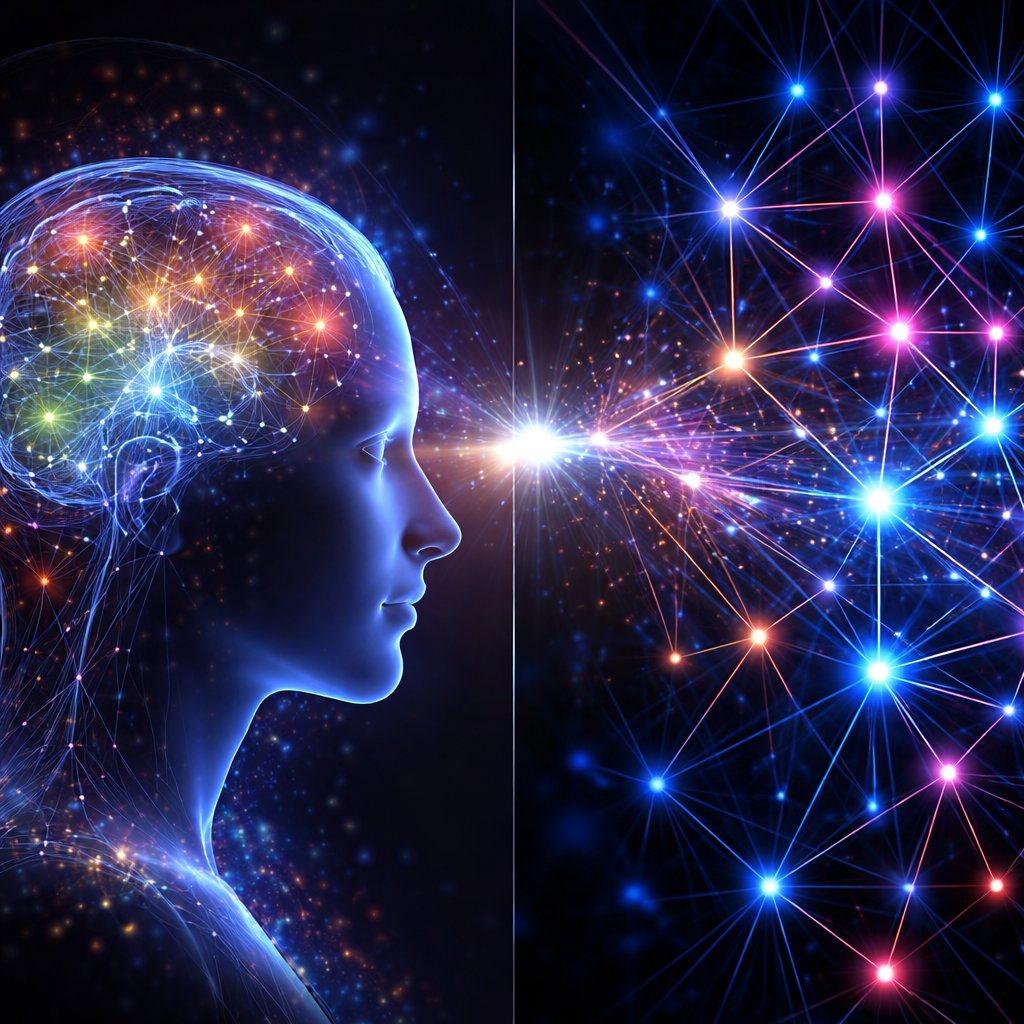
Think of your brain as a city. Every concept is a node (a neighborhood), and every idea connection is a road between neighborhoods. When you think of a “tiger,” your brain lights up related nodes like “cat,” “stripes,” “predator,” or “jungle.” The way these nodes connect—how short or long the routes are, how many communities exist, and how easily you can jump from one cluster to another—shapes how you brainstorm and, ultimately, how original your ideas feel.
In cognitive science, those connections form a semantic memory network. It’s often studied with graph theory: nodes (concepts) and edges (associations). A more flexible network—shorter routes, tighter cross-links between ideas, and fewer separate sub-networks—tends to support more novel associations. That’s been shown in a lot of human creativity research (the classic “flexible networks fuel originality” idea). The study we’re discussing borrows those ideas and asks: do AI systems like ChatGPT organize knowledge in a similar way? And if yes, does that structure connect to originality in the same way as in people?
From memory maps to creative sparks: why it matters for originality
The authors use specific network metrics to quantify network shape:
- Average Short Path Length (ASPL): how easily you can get from one concept to another across the whole network.
- Clustering Coefficient (CC): how tightly knit a node’s neighbors are (are ideas bunched in groups?).
- Modularity (Q): how well the network splits into distinct communities or sub-areas.
- Percolation analysis: how the network breaks apart when you remove weaker connections, which reveals how robust or fragile the network is under “attacks” (think pruning or noise).
In humans, prior work suggests higher creativity goes hand in hand with a flexible, well-connected network that’s robust to targeted disruptions. The question is whether a language model like GPT-4o shows a similar pattern, and whether its originality correlates with network structure in the same way. The researchers address this by constructing semantic networks from verbal tasks (verbal fluency and free association) and then comparing the AI’s networks to those of two human groups (higher creative and lower creative individuals), all using a consistent pipeline.
Originality under pressure: AI vs human creatives
The experimental setup: who, what, how
- Participants: 81 psychology students, split into Higher Creative Humans (HCH) and Lower Creative Humans (LCH) based on a median split of AUT originality scores.
- The AI: ChatGPT-4o accessed via its standard chat interface (no adjustable hyperparameters visible to the researchers).
- Tasks: The same three tasks were given to humans and the AI:
- Verbal Fluency (animals; fruits/vegetables) and Free Association to build semantic networks.
- Alternate Uses Task (AUT) to measure originality at total-production level and at top-3 originality peaks.
- Analysis: All responses were coded for originality by two blind raters. Networks were built from the verbals with TMFG (Triangulated Maximally Filtered Graph) to control noise and ensure comparability across groups. They compared GPT, LCH, and HCH on originality and on network structure (ASPL, CC, Q) and used percolation to assess resilience.
Key findings you can actually use
- Originality comparisons:
- HCH outperformed GPT in originality (as measured by AUT, both across total production and top-3 original responses).
- GPT outperformed LCH, showing that even a less flexible network can produce original outputs relative to lower creativity humans.
- In numerical terms (from the mixed-model analyses):
- For total production originality: GPT > LCH, GPT < HCH; HCH > LCH.
- For top-3 originality peaks: GPT > LCH, GPT < HCH; HCH > LCH.
- Semantic network structure:
- GPT’s network showed greater average path lengths (ASPL larger), weaker local clustering (lower CC), and higher modularity (Q) than both human groups. In other words, its network was more rigid and more compartmentalized.
- Among humans, the HCH network was more flexible and cohesive than LCH (lower ASPL, higher CC, and more robust percolation resilience).
- Percolation (robustness to removing weaker connections):
- GPT’s network fragmented more quickly under increasing thresholds, indicating less resilience.
- LCH and HCH networks showed greater resilience, with HCH showing the strongest integrity across thresholds.
- A holistic takeaway: the AI’s semantic map is less traversable across distant concepts and less cohesive, yet it can still generate original outputs that compete with lower-creative humans.
- The role of motivation and prompts:
- The paper highlights that human creativity is influenced by motivation, affect, and cognitive effort. Lower-creative humans may have had less motivation or more fatigue under evaluation, which could dampen originality. The AI’s performance may partially reflect its hyper-optimized computation and prompt-following, rather than a truly human-like creative drive.
- The authors note that prompt design and hyperparameters (like temperature) can modulate AI creativity, though the exact effects are still an open question. The study used a strict, standardized prompting approach to keep the comparison fair, but real-world use often involves iterative prompting and role-play that can push AI creativity in different directions.
Network structure, percolation, and implications
Structural metrics that matter
- ASPL (Average Short Path Length): In these networks, GPT’s ASPL was higher than both human groups, meaning you’d need to traverse more steps to connect distant concepts. Humans, especially HCH, tend to have shorter connective routes that allow rapid leaps to remote ideas.
- CC (Clustering Coefficient): GPT had lower CC, i.e., fewer tight clusters around ideas. Higher-creative humans formed denser neighborhoods of related concepts, which supports flexible wandering and novel associations.
- Q (Modularity): GPT showed higher modularity, implying more distinct, isolated communities within its semantic map. Humans had more integrated networks across communities.
- Percolation and Largest Connected Component (LCCS): GPT’s network disintegrated faster as thresholds rose, signaling less robustness. In contrast, human networks—particularly HCH—held together better, suggesting a sturdier substrate for cross-domain associations.
Percolation and resilience: how ideas hold together (or don’t)
The percolation analysis acts like stress-testing the semantic map. A more resilient network keeps more of its structure when you prune weaker links, allowing you to still connect disparate ideas. The GPT network’s steeper percolation curve and lower integral (under the curve) indicate that its idea web is less forgiving under constraints. For humans, especially higher creative individuals, the semantic web is more forgiving and continues to link ideas even as connections get strained. In practical terms, this suggests humans may be better at sustaining creative exploration when prompts, time pressure, or distractions intensify, whereas an AI’s “semantic landscape” can crumble more quickly if not carefully tuned.
Hyperparameters, motivation, and the art of prompting
One of the most intriguing angles is the discussion around how AI configuration might mimic human creative control. The Entropy Modulation Theory of Creative Exploration suggests that even if the semantic structure is similar, higher creativity can emerge if a system modulates activation variance or production thresholds. For humans, that’s executive function at work; for AI, it could be about the temperature setting, top_p, etc. The study used a fixed chat interface, which means researchers didn’t tweak these knobs. Yet they note that users can coax more or less originality via prompting strategies, including roleplay, iterative prompting, and explicit constraints. In real-world CSTs, giving users transparent control over these "creative lenses" could help balance consistency with novelty.
Implications for Creativity Support Tools
- Artificial Creativity is a process, not just a product: The authors argue that AI creativity should be studied as the dynamic interaction between process (semantic memory structure) and product (idea originality). For CSTs, this means designing tools that support both the AI’s capacity to suggest novel ideas and the human partner’s ability to guide, critique, and reframe those ideas. Interfaces that visualize the model’s semantic map and allow users to steer its exploration could foster more meaningful collaboration.
- Average performance vs. excellence: ChatGPT-4o’s AUT scores sat near average human performance, but with the notable caveat that it did not reach the extremes of higher-creativity humans. This “average but reliable” profile has pragmatic value: AI can augment teams by consistently contributing useful ideas without necessarily dominating the most original breakthroughs. Designers should consider CSTs that blend AI’s speed with opportunities for human leadership in the most novel directions.
- Prompts as a design variable: Prompt design matters. The same underlying model can produce different creative outcomes depending on prompts, roleplay, and task framing. CSTs can incorporate prompt-mrompting loops, “seed incident” prompts, or situational personas to expand the semantic space the AI explores, potentially yielding more genuinely surprising outputs.
- Visualization and control of semantic space: The semantic-network metaphor opens up design opportunities. Visual tools that map the AI’s conceptual space, show clusters, and let users “re-wire” connections could enable artists and researchers to seed AI exploration intentionally, encouraging more diverse and transformative outputs.
- Real-world creativity requires more than AUT: The authors acknowledge AUT’s popularity in AI creativity research but also its limits. Real-world creative tasks demand multiple measures (flexibility, elaboration, cross-domain knowledge, humor, and narrative coherence). CSTs should provide multi-faceted feedback and evaluation dashboards to capture a broader palette of creative dimensions.
In-body link to the original paper
As you read, you’ll notice how the study elegantly ties together cognitive theory and AI practice. For a deeper dive into the methods (TMFG networks, percolation, and the exact statistical modeling) and the full results, see the original paper linked earlier in this article: Are Semantic Networks Associated with Idea Originality in Artificial Creativity? A Comparison with Human Agents, https://arxiv.org/abs/2602.02048.
Key Takeaways
- The AI’s semantic network is structurally different from human networks: GPT-4o tends to have longer path lengths, sparser local clustering, and higher modularity, indicating a more rigid and compartmentalized map of concepts.
- Originality outcomes vary by comparator group: Higher creative humans outperform AI in originality, while AI can exceed lower creative humans, suggesting that AI creativity sits between average and exceptional human performance depending on who you compare it to.
- Robustness matters: AI networks frag under pressure more quickly than human networks, which suggests that merely cranking up AI’s raw power isn’t enough for resilient, cross-domain originality. We need smarter prompting, role-play, and interactive interfaces to compensate.
- Design implications for CSTs: Treat artificial creativity as a process that can be guided by explicit control over prompts and semantic-space visualization. Build interfaces that let users shape the AI’s exploration, compensate for structural rigidity, and foster genuinely transformative collaboration rather than homogenization.
- Future research directions: Systematic manipulation of AI hyperparameters, broader creativity measures beyond AUT, and more ecologically valid tasks are needed to map how network structure and originality co-evolve in AI—and how humans and machines can best amplify each other’s strengths.
Sources & Further Reading
- Original Research Paper: Are Semantic Networks Associated with Idea Originality in Artificial Creativity? A Comparison with Human Agents
- Authors: Umberto Domanti, Lorenzo Campidelli, Sergio Agnoli, Antonella De Angeli
Notes for readers who want to explore deeper
- If you’re a CST designer or a researcher, the study’s emphasis on TMFG-based network construction and percolation analysis offers a practical toolkit for comparing AI and human semantic structures. The network metrics (ASPL, CC, Q) and the percolation approach provide concrete levers you can apply to your own experiments.
- For practitioners focused on prompting, the discussion around entropy modulation and role-play prompts points to actionable experiments: try varying prompts to shift the AI’s exploratory behavior, then measure changes in originality and the coherence of ideas across related prompts.
Whether you’re building a creative brainstorming aid, an AI art partner, or a writing collaborator, this research underscores a simple but powerful idea: the way ideas are connected in a memory-like map—whether in a human mind or a language model—shapes what we end up producing. The future of intelligent creativity lies not in a single clever prompt or a flashy model, but in tools that let humans and machines tune the connective tissue of ideas together, balancing structure with surprise. And that balance—between the rigidity of networks and the flexibility of imagination—might just be the secret sauce of genuinely collaborative creativity.