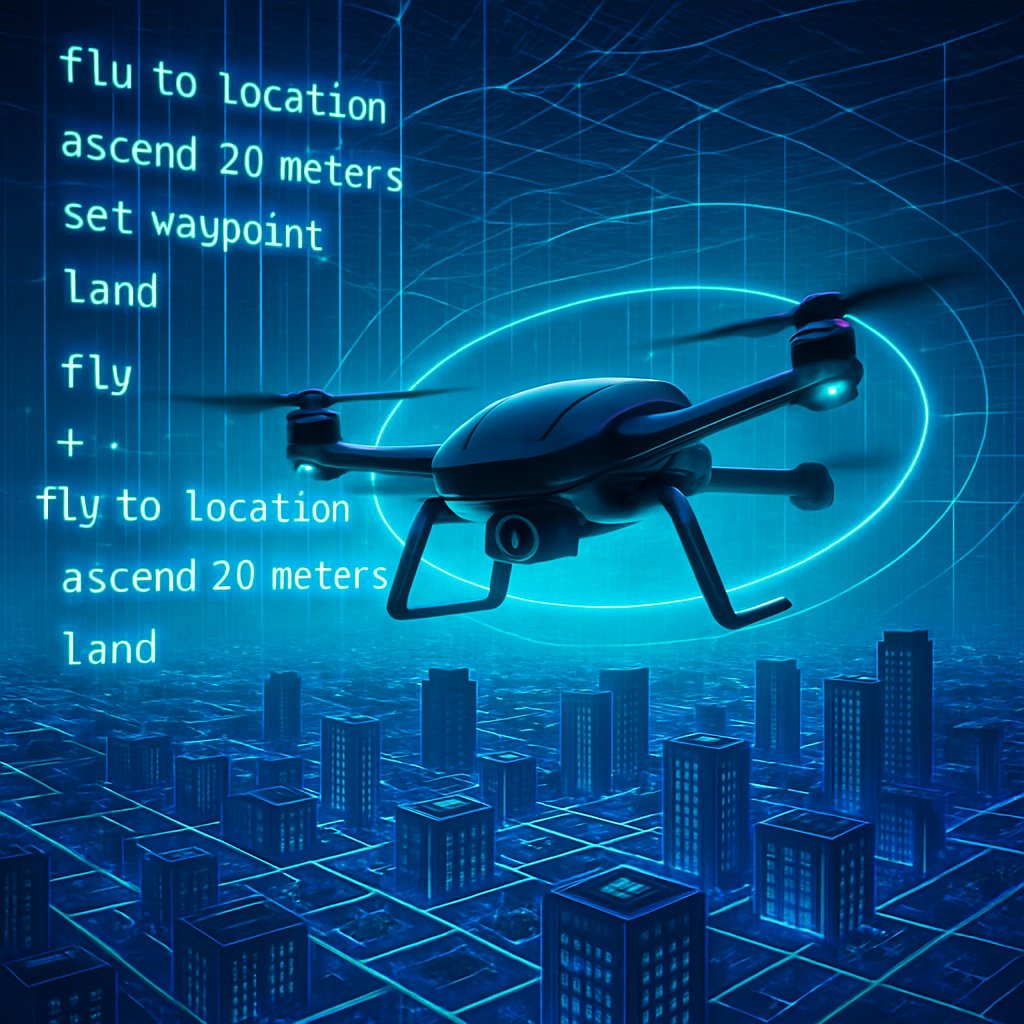
Title: LLM-Driven Drone Control in Simulation: Turning Natural Language into Real Tasks
Table of Contents
- Introduction
- Why This Matters
- NL-to-PL Translation with CodeT5
- Data Assembly, Training Pipeline, and System Architecture
- AirSim Integration, Real-Time Execution, and Practical Implications
- Experiments, Evaluation, and Real-World Readiness
- Key Takeaways
- Sources & Further Reading
Introduction
Drones are increasingly woven into everyday life—from environmental monitoring to emergency response. Yet getting a drone to do a sequence of tasks typically requires specialized programming or rigid control interfaces. The new research, presented at the 1st International Conference on Drones and Unmanned Systems (DAUS’ 2025), investigates how large language models (LLMs) can bridge human intent and drone action, specifically by fine-tuning CodeT5 to translate natural language prompts into executable drone code within a high-fidelity simulation environment. The work, documented in the paper Large Language Models to Enhance Multi-task Drone Operations in Simulated Environments, demonstrates a pathway to make multi-task UAV operations more accessible and efficient by letting users communicate with drones in plain language and receiving concrete, runnable code in return. If you want to peek at the source material, you can read the original paper here: https://arxiv.org/abs/2601.08405.
What makes this line of work compelling is not just the novelty of “talking to a drone” but the practical promise: reduce the operational threshold for non-experts, accelerate prototyping and testing, and push drone capabilities further by combining natural language understanding with domain-specific code generation. The authors—Yizhan Feng, Hichem Snoussi, Jing Teng, Abel Cherouat, and Tian Wang—build a pipeline that starts with NL prompts, translates them into Python code snippets that drive a simulated drone in AirSim (an Unreal Engine-based simulator), and then executes those commands within the simulation. It’s a thoughtful blend of language models trained on code and a flexible, visually rich environment that supports realistic physics and a variety of drone platforms.
Why This Matters
Right now, AI researchers and robotics practitioners are asking a common question: can we make autonomous or semi-autonomous drones easier to control, especially in dynamic, multi-task scenarios? This work answers with a pragmatic approach: instead of layering on heavier autonomy per se, use a targeted language-to-code translator tailored to drone tasks. The significance is twofold. First, it lowers the barrier to entry. If a researcher, student, or field operator can describe a task in ordinary language—“track a moving object, capture high-res drone footage, and return to base while keeping a safe altitude”—and have the system generate executable steps, you’ve just decoupled task specification from low-level control. Second, the research capitalizes on recent LLM trends, but with a crucial twist: they fine-tune CodeT5 on a domain-specific corpus of
This work also sits in the broader arc of AI-assisted robotics. Previous efforts often relied on end-to-end policy learning in simulators like PX4/Gazebo, or used chat-based tools that were powerful in conversation but limited when it came to domain-specific code execution. Here, the authors explicitly address latency and reliability. They emphasize concise, executable code generation rather than verbose dialogue, which is a practical design choice for real-time drone operations. If you’ve followed the literature on robotics “LLM-brains” like ChatGPT-augmented controllers, this paper presents a more focused, engineering-friendly path: a neural translator that outputs concrete code, ready to run in a performant AirSim environment.
NL-to-PL Translation with CodeT5
One of the core ideas is straightforward in spirit but powerful in practice: translate natural language prompts into programmable Python commands that drive a simulated drone. The authors craft a two-part training dataset to cover both simple and complex tasks.
Simple commands: This part is a JSON mapping from natural language to Python code snippets. Think of it as a cookbook where a user says a basic instruction like “take off,” “adjust altitude to 20 meters,” or “capture an image,” and the model retrieves the corresponding, executable Python snippet. The goal here is not advanced reasoning but reliable, fast code generation for everyday drone actions, state configurations, and image acquisition.
Complex tasks: For more sophisticated missions—object recognition, autonomous navigation, dynamic tracking—the authors rely on developer-provided code as training data. They maintain a dynamic
pairing that represents higher-level behaviors the drone should execute. This part of the dataset captures the nuanced control logic, sensor processing, and decision-making steps that go beyond the basics.
Training uses an open-source model called CodeT5, which is designed for code understanding and generation and has the benefit of being tuned for identifier awareness and syntactic accuracy. The researchers argue that CodeT5’s encoder-decoder architecture, combined with CodeT5’s pre-training on code, makes it well suited for translating NL prompts into syntactically correct, executable code. They train the model on their curated NL-PL pairs and then deploy it inside a Python-based conversational agent that talks to a C++ interface tied to AirSim.
In practice, a user’s natural language instruction is fed into the fine-tuned CodeT5, which outputs executable code lines. The user can review and confirm the code before it’s sent to the AirSim drone for execution. This guardrail—human-in-the-loop confirmation—helps prevent misinterpretations and ensures that the generated code aligns with the user’s intent before any action is taken in the simulation.
Data curation matters here. The authors emphasize a dataset that covers both broad, generic commands and scenario-specific tasks. The approach aims to maintain transferability across different UAV brands and models, which is essential in a world where drone platforms vary a lot. The pipeline also explicitly contrasts with some earlier “chat-first” approaches by foregrounding code generation speed and reliability, which are critical for real-time drone control.
Data-wise, the system benefits from a combination of ChatGPT-generated NL-code pairs and developer-provided code for more involved tasks. The result is a corpus that supports rapid translation for routine operations and robust, nuanced control for complex behaviors, all within a single pipeline.
Data Assembly, Training Pipeline, and System Architecture
The research design is a thoughtful blend of data assembly and system integration. Here’s how the pieces fit together, in practical terms:
Dataset construction: Start with a general set of NL commands mapped to Python code in a JSON structure for everyday drone actions. Then layer in complex tasks whose code is supplied by developers. The dataset thus covers both flat control commands and richer, task-oriented instructions.
Learning objective: Train CodeT5 to learn NL-to-PL mappings. The output is not a textual reply but executable code that can be executed by the AirSim interface. The focus is on producing concise, correct code rather than elaborate natural language responses.
System integration: A Python-based conversational agent handles user prompts and passes code to a C++ AirSim interface. After asynchronous connection is established, the agent generates code, displays it for user confirmation, and then sends it to the simulated drone once approved. This architecture keeps latency in check and ensures robust real-time behavior.
The role of AirSim: AirSim delivers high-fidelity physics and visuals, providing a realistic playground for testing multi-task drone operations. The Unreal Engine-based environment can simulate a wide range of dynamic scenes, lighting conditions, weather, and object interactions, which helps researchers study how well NL-to-PL translations perform under realistic constraints.
Linking to knowledge sources: For readers who want more depth, the paper goes into how the AirSim environment supports a broader set of modules and scenarios, enabling researchers to go beyond simple parking lot demos into more challenging, multi-scenario experiments. For context and further reading, you can also explore related work cited in the paper, including prior efforts to apply ChatGPT in robotics and other code-generation techniques.
AirSim Integration, Real-Time Execution, and Practical Implications
The bridge from language to action hinges on AirSim’s capability to execute Python-generated commands with real-time fidelity. A few practical implications stand out:
Real-time task execution with low latency: The authors deliberately prioritize concise code generation to minimize drone idle time. In practice, this matters when you want a drone to respond quickly to a user’s instruction, such as “follow that vehicle and maintain a 5-meter buffer,” or “switch to infrared imaging if a heat source is detected.” Latency isn’t just a nuisance; it can be the difference between a successful mission and a missed target.
Visual-rich, flexible environments: AirSim’s Unreal-based engine supports complex, dynamic scenes that resemble real-world contexts more closely than more simplified simulators. This realism matters because it pushes the NL-to-PL translator to handle the kinds of perceptual and control challenges drones face in the field.
Modularity and transferability: By building the system around an open-source model (CodeT5) and a modular architecture, the researchers emphasize adaptability. The idea is to make it feasible to apply the same NL-to-PL translator across different drone platforms and mission types, simply by swapping in platform-specific code templates or adjusting the dataset to capture new commands and capabilities.
Human-in-the-loop safety and validation: The workflow includes user confirmation before code execution, which acts as a safety valve. This is especially important in unmanned systems where unintended commands could have safety implications. The design choice to require confirmation reflects a prudent approach to deploying AI in critical control tasks.
Practical scenarios today: A real-world scenario might involve a search-and-rescue operator describing a job in plain language—“scan the forest edge for heat signatures, relay live video to base, and return to home if battery drops below 20%”—and the system generating the required Python commands to configure the drone, start the thermal camera, stream video, and implement a safe return-to-base protocol. While the work is demonstrated in simulation, it provides a blueprint for how such capabilities could function on real drones after careful validation and safety testing.
Experiments, Evaluation, and Real-World Readiness
The paper’s experiments focus on the accuracy and reliability of the NL-to-PL translation, as well as the end-to-end task execution within the AirSim environment. The evaluation looks at three dimensions:
Syntactic correctness: Are the generated code snippets well-formed Python commands that can be parsed and executed without errors? Syntactic integrity is crucial; a small syntax slip can derail a task in mid-flight.
Task effectiveness: Do the executed commands accomplish the intended objective? The researchers compare the outcomes of generated commands against manually written, standard commands to gauge consistency and reliability.
Conformance to command formats: The system checks whether the output adheres to the expected structure of the drone control commands, which helps ensure predictability and ease of integration with downstream systems.
The approach includes a visualization of the end-to-end flow: a user problem is translated to a sequence of executable code lines, the user reviews, and then the drone executes the code in AirSim, returning outputs such as images, status data, or video. This end-to-end view highlights practical strengths and potential bottlenecks, especially around latency, reliability, and situational understanding.
In the context of real-world readiness, the authors acknowledge limitations and map out future directions. They propose expanding task categories, enhancing modular adaptability, and extending the system to real UAVs beyond simulators. In other words, the current work provides a solid demonstration in a controlled, high-fidelity simulation, offering a practical path toward real-world deployment after thorough safety certification and rigorous testing.
Key Takeaways
- The core idea is to translate natural language instructions into executable drone code using a fine-tuned CodeT5 model, enabling multi-task operations in a realistic simulation environment (AirSim).
The two-part training dataset—simple NL-to-Python mappings for common commands and developer-provided code for complex tasks—delivers both speed and sophistication in drone control.
The system architecture emphasizes low-latency, deterministic behavior by prioritizing concise code generation and a Python-to-C++ bridge for AirSim, plus a human-in-the-loop confirmation step for safety.
AirSim’s realistic physics and visuals provide a valuable testbed for validating NL-to-PL translation in scenarios that resemble real-world drone missions, paving the way for safer and more capable human-robot collaboration.
The research builds on prior AI robotics work by focusing on a practical, code-driven translation mechanism rather than relying solely on high-level conversational capabilities, addressing latency and reliability concerns that matter in flight.
While the study is demonstrated in simulation, the authors outline a clear path to extending the functionality to real UAVs and broader task categories, suggesting a future where non-experts can orchestrate complex drone operations through natural language.
For readers curious to dive deeper, the original paper offers a detailed account of the methodology, experiments, and the broader context of related work in LLMs, UAVs, and code generation. If you’re exploring how to bring language models into robotics workflows, this study is a compelling example of turning “tell it what to do” into concrete, executable steps in a controlled, testable environment. For more context and to explore the cited prior work, you can consult the linked paper here: Large Language Models to Enhance Multi-task Drone Operations in Simulated Environments.
Sources & Further Reading
- Original Research Paper: Large Language Models to Enhance Multi-task Drone Operations in Simulated Environments
- Authors: Yizhan Feng, Hichem Snoussi, Jing Teng, Abel Cherouat, Tian Wang
Note: The article discusses related lines of research, including prior work on ChatGPT-assisted robotics and code-generation techniques, and situates the present contribution as a targeted, open-source, and modular approach designed for practical, real-time drone control within a simulated yet realistic AirSim environment.