The Short Answer
ETA makes embodied AI agents trustworthy by enforcing a strict decide → act → verify loop: execute one world-changing action, then re-check with a fresh observation before the next state-dependent decision. This design prevents open-loop execution where the agent assumes the world stayed the same.
For practitioners, that means building robots with a task-level planner plus a separate execution interface that validates and dispatches bounded actions, while the world returns both results and new observations. The planner can then safely continue or adjust based on verified outcomes.
The caveat is that ETA’s reliability depends on the loop discipline (one action at a time with observation after each step) and on having an interface gate that enforces safety/allowability; without that structure, trust can’t be guaranteed.
On this page
- Introduction
- Why This Matters
- A Trusted Loop: Agent, Interface, World (Not “One Giant Policy”)
- How OpenETA Implements ETA With Tools, Skills, and Audited Memory
- What They Tested: LIBERO Simulation Results and the Pass@k Story
- When Attempts to Improve Itself Didn’t Yet Pay Off
- From Simulation to a UR5e Robot: What Transfers and What Still Breaks
- Key Takeaways
Embodied AI Agents That Can Be Trusted After Every Move
Introduction
If you’ve been following robotics, you’ve probably asked the same question everyone’s thinking: when does a robot get its “ChatGPT moment”—the kind where it can handle unfamiliar tasks, in new environments, without becoming a liability?
This new research from the ETA paper (the authors introduce “ETA: A New Agentic Paradigm for Embodied Tasks”) takes a very practical swing at that problem. Instead of betting everything on one huge model that directly maps vision to motor actions, it proposes a different recipe: build an embodied agent around a tight, inspectable loop of “decide → act → verify.” The result is a system design called the Embodied Task Agent (ETA), implemented in an open-source framework called OpenETA.
The core idea is simple to say but hard to engineer: the agent can’t just “wing it” over long physical sequences. After every world-changing step, it must re-check the world, record what happened, and only then decide what comes next. In other words: no unobserved leaps, no silent hallucinations—at least not in the physical loop.
Why This Matters
Robotics is stuck on a frustrating mismatch: many AI systems are great at producing plausible actions, but robots need something stronger—controllability you can audit. That’s especially relevant right now because we’re seeing more “generalist” language and multimodal models being packaged into agents. People want “one agent to rule them all,” but physical environments don’t forgive guesswork. If a robot can’t reliably tell you what it observed and what it changed, it can’t be safely scaled beyond demos.
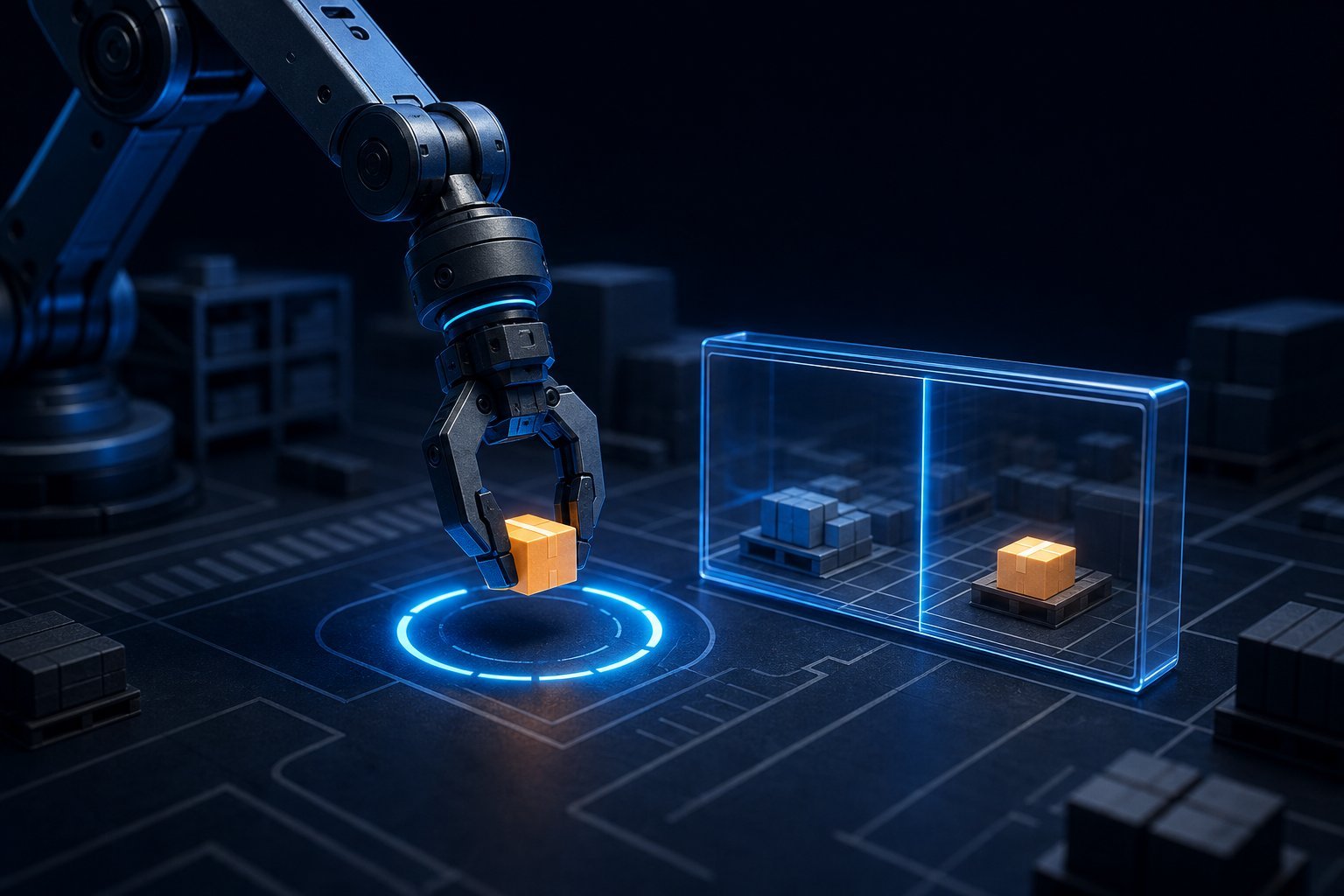
A concrete scenario you could apply this to today: imagine a warehouse assistant robot that needs to pick and place items with different shapes, on different days, from slightly different layouts. Even if it has decent grasping skills, the “hard part” is the long tail: What if the object is in a new pose? What if the grasp fails? What if placement alignment is off? ETA is aiming at exactly that: a task-level planner that can call specialized capabilities, then verify the outcome before continuing. That kind of control loop is closer to how humans operate—try, observe the result, adjust—rather than “plan everything in your head and execute blindly.”
Compared to prior robotics approaches that lean heavily on end-to-end perception-to-action learning, ETA builds on a newer agent pattern from digital domains (tool-use loops) but adapts it for the physical world. Earlier work like language-agent tool frameworks interleave reasoning with actions and observations; ETA basically says: that loop is necessary but not sufficient. In the physical world you also need bounded, verifiable atomic actions plus a gatekeeper interface that prevents the planner from quietly skipping safety checks or fabricating “success.”
A Trusted Loop: Agent, Interface, World (Not “One Giant Policy”)
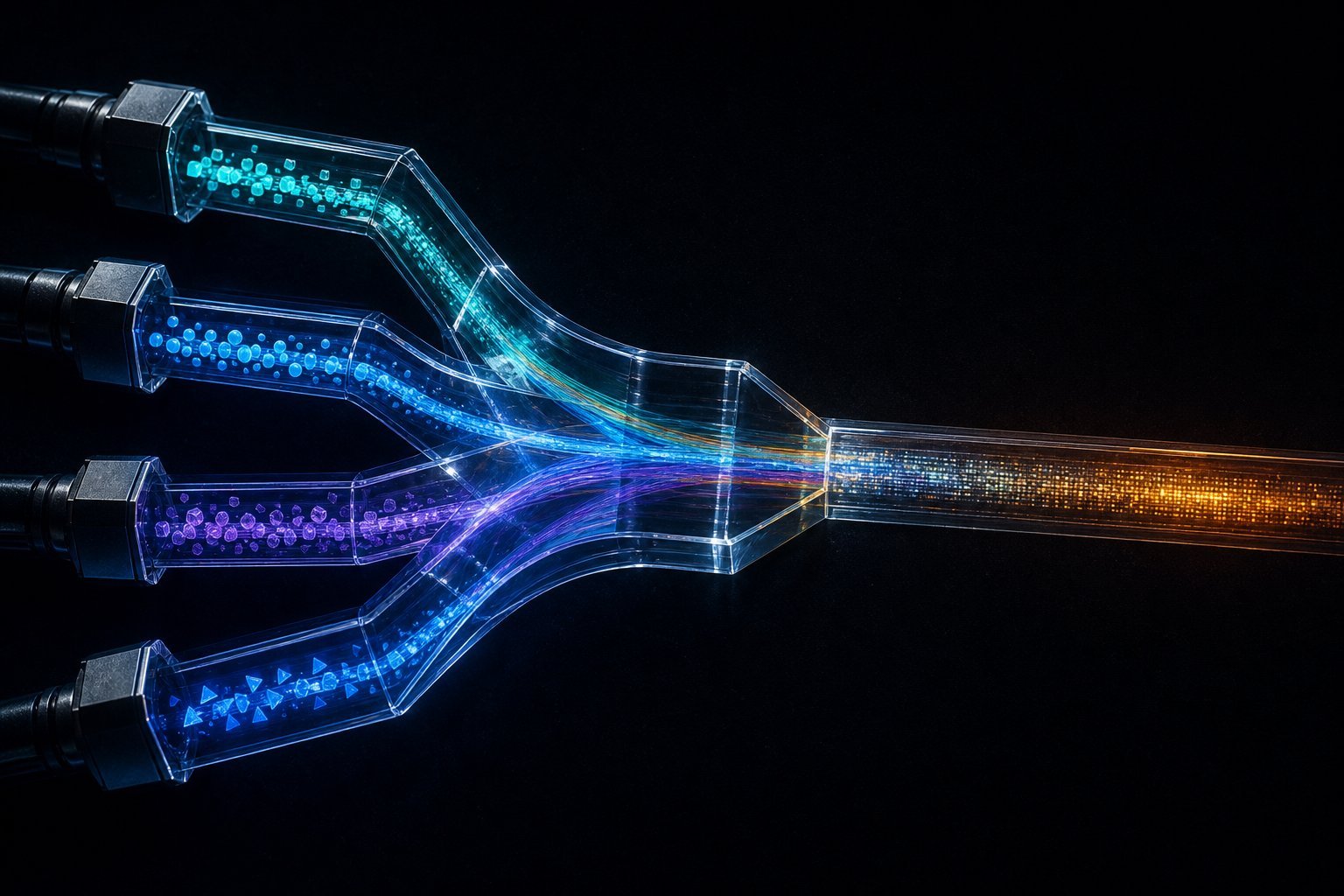
ETA doesn’t treat robotics as “let the model control everything.” Instead, it splits the system into three roles with different responsibilities:
- Agent (task-level intelligence): interprets the natural-language goal, maintains working memory, and proposes the next command.
- Interface (execution authority + safety gate): validates that the command is structurally correct, allowed, and safe to run—then dispatches it.
- World (the real executor): performs the atomic action and returns the result plus a fresh observation.
The key rule: one world-changing action at a time
Here’s the paradigm shift. Every ETA step follows a strict requirement:
Execute only one world-changing action at a time, then obtain a fresh observation before the next state-dependent action.
This is basically the anti-“open-loop” rule. Instead of running a chain of actions while assuming the world stayed stable, ETA forces re-checking after each change. That helps avoid a classic robotics failure mode: the robot acts based on an old state estimate, the scene changes (slippage, occlusion, contact dynamics), and the rest of the sequence drifts into nonsense.
Why this helps with controllability
ETA also turns “controllability” into something measurable. It requires:
- Explicit task state over long horizons (working memory with obligations)
- Bounded action interfaces (atomic tool calls rather than free-form motor code)
- Decision-making based on actual execution results, not predictions alone
In practice, this design makes the robot’s behavior inspectable: you can replay trajectories, audit each command, and see what evidence the planner had at every decision point. That’s a big deal for evaluation, debugging, and future self-improvement.
How OpenETA Implements ETA With Tools, Skills, and Audited Memory
OpenETA is the open-source runtime that wires the ETA protocol into something you can run, swap, and test. The important part is that it’s modular: it doesn’t require one monolithic model to do everything.
Tools: atomic capabilities with contracts
A Tool in OpenETA is a host-registered atomic capability with a stable parameter/return contract. By default, the registry contains 44 Tools. Each tool declares a side-effect class (like read_only, planning, bookkeeping, world_mutating) which influences how it can be batched and whether a fresh observation must follow.
Think of Tools as “robot verbs” with a contract. For example:
- a segmentation tool that proposes object masks,
- a grasp planner that proposes grasp candidates,
- a placement tool that suggests where an object could go,
- or a trajectory generator that respects collision constraints.
The planner can call these verbs, but the interface ensures they’re allowed and safely executed.
Skills: editable guidance the interface still won’t let you misuse
A Skill is textual guidance that instructs the agent how to reason/check/recover. But Skills can’t secretly execute multi-step actions behind the scenes. The agent must still explicitly select every atomic Tool.
So Skills are about how to think and verify, not about bypassing the physical action pipeline.
AtomActions: the actual physical primitives
AtomActions are the subset of physical actions that can physically change the world (like end-effector motion or gripper commands). Importantly, Skill text can’t bypass AtomActions. This keeps the system from turning “instructions” into “unverified physical changes.”
Working memory + obligations = “don’t guess; track your pending issues”
OpenETA uses working memory to track what must be resolved. For example, if after an action the system doesn’t have enough evidence that the robot successfully grasped something, the interface creates an obligation to re-check before continuing.
This is where ETA becomes closer to reliable robotics behavior: it doesn’t just act; it keeps score of what’s still uncertain.
The evidence chain: everything becomes replayable
OpenETA records observations, commands, action results, environment receipts, and decision rationales into a replayable trajectory. That’s what allows:
- debugging after failures,
- comparing model strategies fairly,
- and (attempting) improvement later using verified outcomes.
What They Tested: LIBERO Simulation Results and the Pass@k Story
The researchers evaluate OpenETA’s closed-loop performance on LIBERO, a manipulation benchmark. Specifically, they run on multiple suites: Spatial, Object, Goal, and Long / LIBERO-10 (with 10 tasks each), plus additional tasks for broader evaluation.
Formal evaluation condition: no task-specific policy training
OpenETA receives no additional task-specific policy training. Instead, it composes foundation-model reasoning, target localization, segmentation, grasp planning, motion control, and environment checking through Tools.
Their default simulation setup includes:
- Planner: GPT-5.6-Luna (gpt-5.6-luna) with medium reasoning effort in the full setup
- Success criteria: official positive LIBERO reward in a trusted environment receipt
The headline result (full matrix)
They report a frozen evaluation baseline on a matrix of 40 tasks × 10 seeds = 400 episodes, with success counted using the official reward.
56/400successful episodes =14.0%overall success rate.
They also analyze task coverage: out of 40 tasks,
- 22 tasks scored 0/10,
- 0 tasks scored 10/10,
- 18 tasks had mixed outcomes across seeds,
meaning 18/40 tasks succeed at least once.
Failures are dominated by timeouts
Among 344 failed episodes, the most common terminal label is:
- episode_timeout = 215/344 = 62.5%
The paper also notes other failure types like ask_human (help requests that aren’t treated as successful outcomes) and maximum turns. The key point: the system is sometimes too slow or struggles with long-horizon subgoal coordination and re-checking.
Pass@k comparison: same 3-tool interface, different planners
A particularly informative part of the paper is their “Codex mode” evaluation. Here, OpenETA runs with only three embodied Tools:
- observe
- mark_point
- move_to
This is similar in spirit to how coding agents use a small set of reliable primitives.
They compare three planners: GPT-5.6-Luna, GPT-5.6-Terra, GPT-5.6-Sol. On 130 LIBERO tasks, they report Pass@k (task success rate across seeds). At Pass@5:
| Planner | Tasks solved @Pass@5 (out of 130) | Pass@5 % |
|---|---|---|
gpt-5.6-Luna |
62 | 47.7% |
gpt-5.6-Terra |
83 | 63.8% |
gpt-5.6-Sol |
117 | 90.0% |
Also notable: Sol solved 92 tasks on the first seed, showing strong planning leverage even with a very small physical interface.
The evaluation isn’t perfectly “infrastructure clean”
The paper flags an issue: 3 LIBERO-10 episodes lack complete result records due to simulator TTL expiration, leaving a diagnostic success rate of 56/397 = 14.11% after excluding those cells. But they emphasize that this doesn’t replace the primary 56/400 metric.
So you should interpret the baseline as descriptive, not a final definitive proof—though the protocol is still strong enough to inform design priorities.
When Attempts to Improve Itself Didn’t Yet Pay Off
A natural question after building an agent with replayable trajectories is: can it learn from its experiences? OpenETA tries constrained agent self-evolution—but with strict gates so the agent can’t “rewrite the rules” or accidentally degrade safety.
The promotion gate: candidate updates must survive multiple tests
The runtime allows candidate skill/strategy updates only if they pass a sequence of checks, including:
- deterministic contract checks,
- isolated review,
- replaying the same task to reproduce the original success,
- and held-out evaluation to ensure no regression.
They test three kinds of updates:
1. Task-local Skill edits (change full workflow guidance)
2. Exact-task playbooks (extract a playbook from a successful trajectory, but only when task/environment text matches)
3. Stage-local deltas (derive a symbolic trigger + stage change from a successful vs failed trajectory)
Main result: no candidate passed all gates
In their LIBERO Spatial experiments, the outcome is blunt:
- No update passed all promotion gates.
Some candidates changed a single run, but effects weren’t stable. The task playbook approach performed worse than baseline, and stage-local deltas failed to reproduce the original success and didn’t reach held-out evaluation.
So OpenETA shows an important mechanism claim: experience should influence behavior only after paired validation—not automatically.
But it also highlights a real challenge: the current self-evolution methods mostly added extra checks/recovery logic without fixing underlying perception/control bottlenecks, which sometimes increased planning turns and timeouts.
From Simulation to a UR5e Robot: What Transfers and What Still Breaks
OpenETA isn’t locked to one simulator or one robot. The paper explains how the agent can move from simulation to hardware by using adapters.
What transfers (ideally)
The task-level loop transfers best:
- observation/action contracts,
- the agent’s working memory logic,
- Tools/Skills,
- fresh-observation obligations,
- and the trajectory/evidence format.
What must be revalidated
Simulation can’t guarantee real-robot safety or control frequency. The paper identifies coupled bottlenecks during development with a UR5e + Robotiq setup:
Depth estimation differences
- Simulator depth is more complete than wrist + third-person depth in real data.
- They tried depth-estimation enhancement, but it didn’t reliably restore geometry needed for high-quality pose estimates.
Acceleration-limit protective stops
- Some lateral-grasp target poses triggered controller safety stops.
- The traces suggest PD tuning or trajectory shaping could matter, but the retained recordings don’t prove the exact cause.
These issues are why the paper emphasizes evidence checks and device-specific validation steps before claiming real performance.
Real-robot demonstrations exist, but audited success isn’t fully closed yet
They provide qualitative recordings (e.g., sponge-to-tray and bell-pepper sequences), which show the tool pipeline can drive substantive manipulation stages. But they also clarify that interface-level integration doesn’t yet rise to a full audited success rate on the real robot.
So the story is: the protocol works enough to operate, but the evaluation rigor for physical success is still developing.
Key Takeaways
- ETA’s core contribution is a protocol, not just a model: after every world-changing action, the agent must get a fresh observation and decide again.
- Controllability comes from architecture: agent proposes, interface authorizes, world executes—and every step is recorded in a replayable evidence chain.
- OpenETA is modular and tool-driven: foundation models act as planners/deciders, while specialized capabilities run behind stable Tool contracts.
- Simulation performance shows promise but also pain points:
56/400successful episodes overall (14.0%), with timeouts (62.5%of failures) dominating. - Planner strength matters even with a tiny physical interface: in Codex mode with only
observe,mark_point, andmove_to, Pass@5 jumps up to 90.0% withgpt-5.6-Sol. - Self-improvement is possible in principle but not yet effective here: no constrained self-evolution candidate passed the full promotion gates.
- Sim2Real transfer is constrained by perception + control realities: depth quality and motion safety stops are key bottlenecks, meaning simulation success doesn’t automatically imply physical success.
If you’re building toward real embodied agents, this paper’s biggest “aha” is that reliability isn’t just about better models. It’s about forcing the system to stay honest about what changed in the world—and making that honesty auditable at every step.
Sources Used
This article is a plain-English breakdown of the following peer-reviewed preprint. Read the original for full methodology and results:
- ETA: A New Agentic Paradigm for Embodied Tasks — arXiv
- Authors: Authors: Yitong Chen, Zezheng Huai, Sixian Li, Yubang Wang, Haozhe Zhang, Yifei Zhang, Hechang Chen, Jingjing Gong, Yu-Gang Jiang, Xipeng Qiu