The Short Answer
SNAIL automatically extracts bioinformatics software and database names from biomedical papers by combining lexical/form signals with context-aware SciBERT modeling. This turns messy tool mentions into structured identification results at scale.
For practitioners, this enables faster, more reliable literature-to-catalog updates—supporting reproducibility audits, tool adoption tracking, and registry maintenance without relying only on brittle keyword matching.
A key nuance is that software/database names can resemble common words, so context matters; purely dictionary- or surface-match approaches will miss or misidentify mentions.
On this page
- Introduction: turning messy bio papers into structured tool usage data
- Why This Matters: the catalog problem is now the bottleneck
- How SNAIL works: a hybrid pipeline that fuses lexical clues with semantic context
- The training data challenge: how they built 134k positive tokens without manual labeling everything
- What SNAIL actually measured: performance wins over domain methods and LLM prompting
- Scaling up to real literature: journal-level “tool preferences” become measurable
- What this enables next (and what you should watch out for)
- Key Takeaways
Bioinformatics tool & database name extraction that actually works (SNAIL)
Introduction: turning messy bio papers into structured tool usage data
If you’ve ever tried to figure out “what software or database did this paper actually use?”, you already know the problem: biomedical literature mentions tools in inconsistent ways—sometimes with acronyms that mean other things, sometimes with branding-like spellings, and sometimes embedded in long sentences that don’t make it easy to search.
A new preprint, based on research published at arXiv:2608.19201, tackles exactly that headache. The researchers introduce SNAIL (Software NAme Identification from Literature), an automatic system for recognizing bioinformatics software/database names directly from biomedical text. The goal isn’t just to “find words that look like tools”—it’s to do this at scale, with high accuracy, across different writing styles and venues.
What’s especially interesting in this work is how the method is built: SNAIL combines two complementary strategies—one focused on surface/form clues (like capitalization patterns and known naming structures) and another focused on meaning in context (using transformer-based embeddings like SciBERT). And to make the model useful in the real world (where new tools appear constantly), they also use a training trick that pushes the semantic model to rely more on context than memorizing the exact token spellings.
In short: this research is about building a reliable “literature-to-catalog” pipeline for bioinformatics resources—so we can track tool usage trends, measure adoption, and keep catalogs up to date without manual curation.
Why This Matters: the catalog problem is now the bottleneck
Here’s the expert take: the hard part of bioinformatics isn’t only running pipelines—it’s maintaining the inventory of what pipelines are made of. Registries like Bio.tools and OMICtools exist, but they can’t perfectly keep pace with the rate at which tools and databases get created, renamed, forked, or used in subtly different ways across subfields.
This is increasingly relevant right now because biomedical teams are being asked to do more “evidence-based” computation choices: selecting tools with known provenance, auditing methods for reproducibility, and comparing approaches across studies. But without an automated way to identify software/database mentions in text, those tasks either (a) happen manually and slowly, or (b) happen with brittle keyword matching that breaks on acronyms and ambiguity.
SNAIL builds on earlier NLP and biomedical NER efforts, but it makes a key distinction: recognizing software/database names is not just like gene/disease NER. Many SW/DB names behave like everyday words (the paper gives examples like blast, era, grasp), so you can’t rely on a stable dictionary and surface matches alone. General-purpose LLMs can sometimes pick them out, but they often sacrifice precision—they may “guess” a lot of entities, which is risky if your downstream step is building a structured catalog.
So compared to prior AI research that treated this like a generic NER problem, SNAIL’s design is more pragmatic: hybrid modeling + context awareness + scalable dataset construction. That combination is what makes it usable for large-scale literature mining—not just a demo.
How SNAIL works: a hybrid pipeline that fuses lexical clues with semantic context
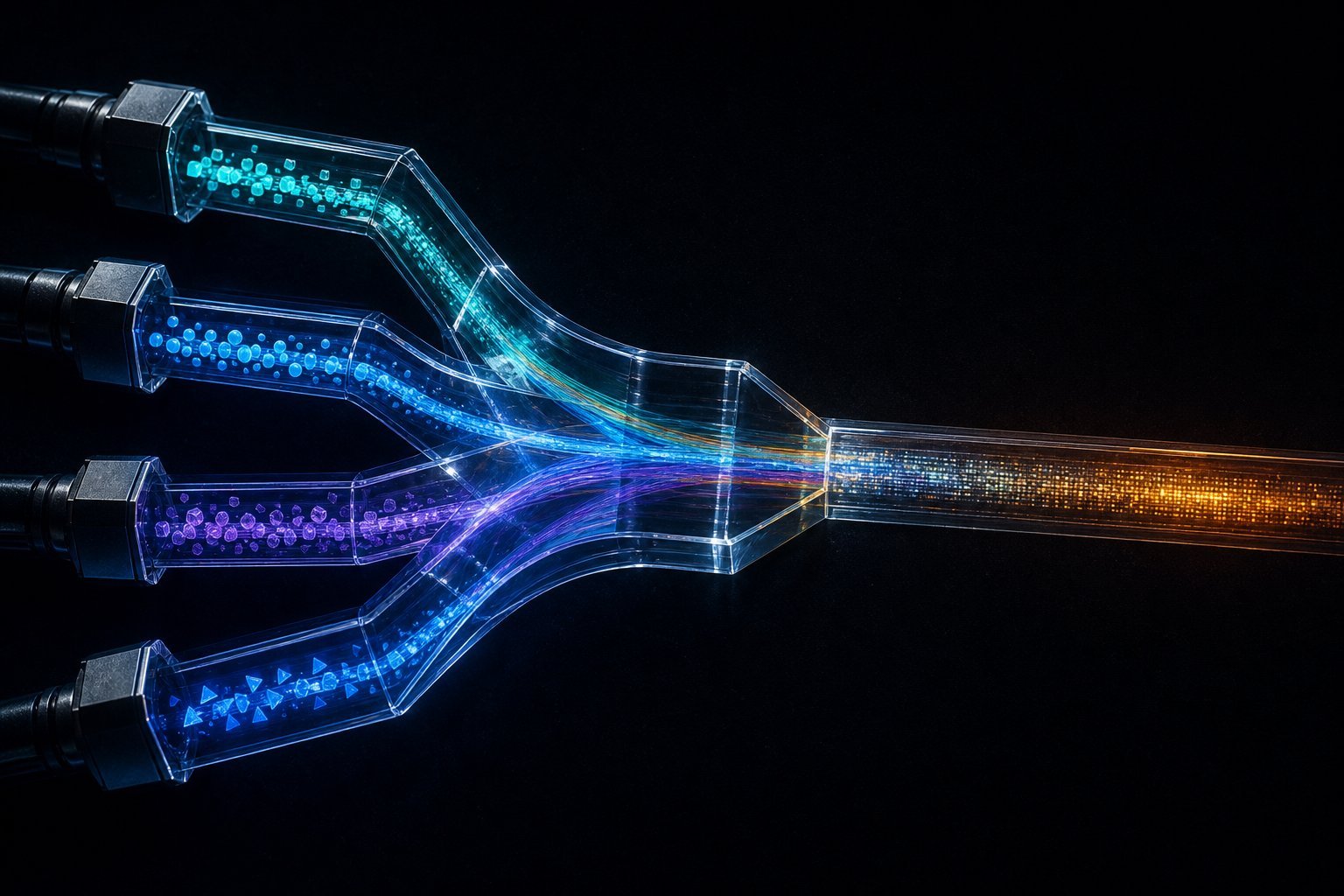
SNAIL’s architecture is a hybrid framework with two separate tracks that then get combined:
SNAIL-lexical: an XGBoost classifier that uses engineered features about how SW/DB names tend to appear (capitalization, abbreviations, syntactic patterns, and dictionary signals).SNAIL-semantic: a transformer-based model (the final version usesSciBERT) that looks at the local context around a candidate token to decide whether it’s likely a software/database name.
The “lexical track” is the pattern hunter
Think of SNAIL-lexical like a meticulous copy editor. It doesn’t understand deep meaning; instead, it checks for cues that tend to be consistent when authors refer to tools:
- casing patterns (e.g.,
BLASTvsblastpvsedgeR) - enumeration structures (e.g., “tools such as
BWA,Bowtie, andSOAP”) - common syntactic patterns like Hearst patterns (phrases such as “such tools as …”)
- dictionary matches against curated lists (including resources adapted from
bioNerDS2, Bioconductor packages, and acronym controls)
The lexical features also include “guardrails” like blacklists for headwords that look like entities but often aren’t (e.g., words that are too generic or ambiguous in general English).
The “semantic track” is the context reader
Now think of SNAIL-semantic like a careful reviewer who looks at what’s going on in the sentence, not just how the token looks. This track uses contextual embeddings from SciBERT (and during model selection they compared other embedding approaches too).
Crucially, they add an extra training trick: explicit token masking. When the model embeds the sentence, it masks the candidate SW/DB token. The semantic model is forced to infer whether the token would be a tool/database name based on the surrounding tokens and syntax—rather than “cheating” by memorizing that exact surface form.
That masking step is part of what helps SNAIL recognize previously unseen entities, which is essential for any catalog that wants to stay current.
The training data challenge: how they built 134k positive tokens without manual labeling everything
If you’ve built NLP models in specialized domains, you know labeling is expensive. You can’t manually annotate every sentence in PubMed just to train a robust named entity model for software and database names.
This paper’s big lever is an automated, two-stage training corpus pipeline:
Stage 1: citation-hinted extraction to get high-confidence positives
They start with a curated catalogue of SW/DB names (each mapped to a canonical publication). Then they scan PubMed articles for exact keyword matches where a mention is consistent with citations in the text.
The logic is: if an in-text keyword match appears in a sentence with citation markers, and the cited reference corresponds to a known SW/DB from the catalogue, then the mention is likely correct. This helps reduce false positives from ambiguous acronyms and accidental lexical overlaps.
Using this approach across 1,000 PubMed articles, they obtained:
- 68,864 sentences containing at least one software name
Stage 2: LLM-assisted distillation to expand coverage and diversity
Next, they use an LLM pipeline (the paper describes prompting ChatGPT) to generate additional labeled examples:
- positive and negative sentence examples
- including “adversarial negative” sentences to teach the model what not to label as a SW/DB entity
They distill this into a final dataset of:
- 50,000 annotated sentences
- 40,000 positive
- 10,000 adversarial negative
Final training corpus size and composition
After merging the citation-hinted data with the LLM-generated distillation data, the final SNAIL training corpus contains:
- 134,681 positive tokens
- 2,441,518 negative tokens
Independent evaluation sets (no training overlap)
They evaluate SNAIL on two separate manually annotated datasets:
DS1: 148,131 sentences (131,209 positive tokens; 2,967,666 negative tokens), annotated in this studyDS2: 60 articles / 8,196 sentences, previously annotated bybioNerDS2(1,325 positive tokens; 195,390 negative tokens)
This “different articles” split matters: it’s one of the best ways to test whether the model learned patterns vs memorizing specifics.
What SNAIL actually measured: performance wins over domain methods and LLM prompting
Let’s talk results, because this is where the paper earns its credibility.
Model selection comparisons: lexical classifier + semantic embedding choices
They tried multiple training configurations:
- CIT: citation-hinted sentences only
- LLM: LLM-generated sentences only
- Both: merged dataset
And multiple model components:
Lexical classifier comparison (trained with merged data, best approach chosen):
| Lexical classifier candidate | Dataset performance (peak F1) |
|---|---|
| XGBoost | 84.6% (DS1), 82.5% (DS2) |
| Others (SVM / logistic regression / random forest / MLP) | consistently lower than XGBoost |
So they used XGBoost for SNAIL-lexical.
Semantic embedding comparison:
They compared embedding approaches including TF-IDF, FastText, BioBERT, and SciBERT. The winning setup was:
- SciBERT with masking, yielding peak
- 87.1% (DS1)
- 86.4% (DS2)
Also, they found masking mattered: explicit token masking improved semantic performance by roughly 6–10% F1 compared to training without masking (for both SciBERT and BioBERT).
The fused model is where the magic compounds
An ablation study shows the key point: lexical and semantic aren’t redundant—they complement each other.
When they combine both tracks (full SNAIL), they report peak performance:
- 94.8% F1 on DS1
- 94.4% F1 on DS2
Benchmark against bioNerDS2 (the previous specialized method)
They benchmark against bioNerDS2 on both DS1 and DS2. The paper states that:
bioNerDS2was around ~62%F1in their comparison baseline- SNAIL pushed
F1to over 90%, with improvements across precision, recall, and F1
The paper also highlights that SNAIL increased recall and precision, meaning it wasn’t just “finding more things”—it was finding them more reliably.
Comparison against general-purpose LLMs (ChatGPT, Gemini, Grok, Claude)
This is a nuanced comparison. Because compute constraints prevented running across the full benchmark sets, they evaluate on two manually annotated full-text articles:
- PMC6082860
- PMC12857227
They prompt each LLM with an instruction like:
“Identify all bioinformatics software, methods and/or database named entities in the given sentence.”
Then they compare precision/recall/F1 against manual annotations.
Across these experiments, the headline claim is clear:
- SNAIL averaged ~82–83% F1
- LLMs were substantially lower overall (with newer generations doing better than older ones)
They also observe a consistent pattern:
- LLMs often have high recall (frequently 80–90%),
- but precision remains lower, dragging down F1.
Meanwhile, SNAIL maintains a more balanced precision/recall trade-off, giving it better overall entity recognition quality for catalog-building.
In other words: LLMs are great at “probably this is a tool,” but SNAIL is optimized to say “this is a tool” with higher confidence.
Scaling up to real literature: journal-level “tool preferences” become measurable
Models are nice—but what do you do with them? This is where SNAIL moves from benchmark to real-world utility.
Large-scale run: 2,000 papers across 10 leading journals
They sample:
- 2,000 scientific articles
- about 200 per journal
- across 10 major bioinformatics journals (including venues like Bioinformatics, Nature Methods, Nucleic Acids Research, and IEEE/ACM TCBB)
Using PubMed IDs from those sampled papers, SNAIL extracts SW/DB named entities.
Top mentioned resources and filtering ambiguity
They identify the 22 most frequently mentioned SW/DB entities, but then manually inspect and remove 9 that either:
- lack unique/identifiable citation sources, or
- are too ambiguous to treat as a clean catalog entry
Removed examples include (as listed in the paper) words like:
- R, ROC, Cluster, S4, Sigma, GenBank, Prism, Ensembl, MIA
That leaves 13 usable resources for deeper analysis.
Mentions correlate with citation impact
For the remaining 13, they compute a correlation between:
- mention frequency in the sampled articles, and
- citation counts
They report:
- Pearson correlation = 0.8
- Spearman correlation = 0.8
- p-value <= 0.001
That’s a strong sign that SNAIL’s extraction reflects meaningful adoption patterns rather than random text noise.
Journal-level clustering reveals subfield preferences
Finally, they do hierarchical clustering based on mention frequencies of the 13 resources across the 10 journals.
Two notable clusters the paper calls out:
- KEGG and Gene Ontology (GO) cluster together (gene function and pathway analysis)
- Protein Data Bank (PDB) and DrugBank cluster together (protein structure and drug-related studies)
They also identify journal-level differences:
- IEEE/ACM TCBB and Briefings in Bioinformatics cluster together, driven by higher mention frequency of PDB
- PLOS Computational Biology, Nucleic Acids Research, and Nature Methods show higher mention frequency of GO relative to PDB
So with SNAIL, you can stop asking “what tools are popular?” as a vague question and start treating it as a quantifiable, per-journal signal.
What this enables next (and what you should watch out for)
This paper is fundamentally about entity recognition, but it opens doors to bigger meta-research questions.
Practical applications you can use today
If you’re building any of the following, SNAIL’s approach is directly relevant:
- automatic population of a bioinformatics tools & databases catalog
- auditing reproducibility by extracting tool names from methods sections
- tool adoption trend analysis (e.g., “how fast is X growing?”)
- journal/subfield preference dashboards for internal research strategy
A clear next step: richer extraction beyond “names”
The authors suggest future improvements like incorporating additional contextual signals:
- citation patterns
- version numbers
- document-level mention frequencies
Also, the obvious extension is to extract relationships and metadata, not just mention boundaries:
- dependencies between tools
- usage contexts (“used for alignment”, “used for variant calling”, etc.)
- categories or functional roles of tools
If SNAIL evolves into that fuller extraction pipeline, it could become a backbone for a continuously updated knowledge base.
The main limitation to keep in mind
Even with high F1, any NER system can still mislabel ambiguous terms. The paper’s large-scale filtering step (removing 9 ambiguous entities) is a reminder: entity recognition is step one, but catalog quality sometimes needs post-processing rules and ambiguity handling.
Key Takeaways
- SNAIL is a hybrid system that identifies bioinformatics software/database names from biomedical literature using both
SNAIL-lexical(XGBoost + engineered features) andSNAIL-semantic(SciBERTwith explicit token masking). - The training dataset was built at scale using a two-stage automated pipeline:
- citation-hinted extraction from 1,000 PubMed articles
- LLM-assisted distillation generating additional labeled examples
- resulting in 134,681 positive tokens and 2,441,518 negative tokens
- On benchmarks, SNAIL reaches peak performance of about 94.8%
F1onDS1and 94.4%F1onDS2, outperforming the specialized previous methodbioNerDS2(~62%F1baseline in their reported comparison). - Compared to prompting general LLMs (ChatGPT/Gemini/Grok/Claude), SNAIL achieves higher overall
F1(~82–83%) by keeping a better precision/recall balance—LLMs tend to have high recall but lower precision. - Applied to 2,000 papers across 10 bioinformatics journals, SNAIL extracts tool mentions that correlate with citation impact (Pearson/Spearman = 0.8) and reveals journal-level preferences (e.g., clustering of
KEGG+GO, andPDB+DrugBank). - This work moves SW/DB recognition closer to a scalable “literature-to-catalog” workflow—useful for reproducibility audits, tool adoption analytics, and continuously updated resource registries.
If you want, I can also turn this into a practical “how to build a similar system” checklist (dataset creation, hybrid modeling choices, and evaluation setup) based strictly on the design decisions SNAIL used.
Sources Used
This article is a plain-English breakdown of the following peer-reviewed preprint. Read the original for full methodology and results:
- Automatic bioinformatic software named entity recognition from literature — arXiv
- Authors: Authors: Hao Xuan, Rithvij Pasupuleti, Ben Liu, Haishuo Sun, Jun Zhang, Zijun Yao, Cuncong Zhong