The ChatGPT Effect on AI Research Networks: Who Collaborates in arXiv cs.AI (2021–2025)
Table of Contents
- Introduction
- Why This Matters
- The Scale-Up: Publication Volumes and Subfield Shifts
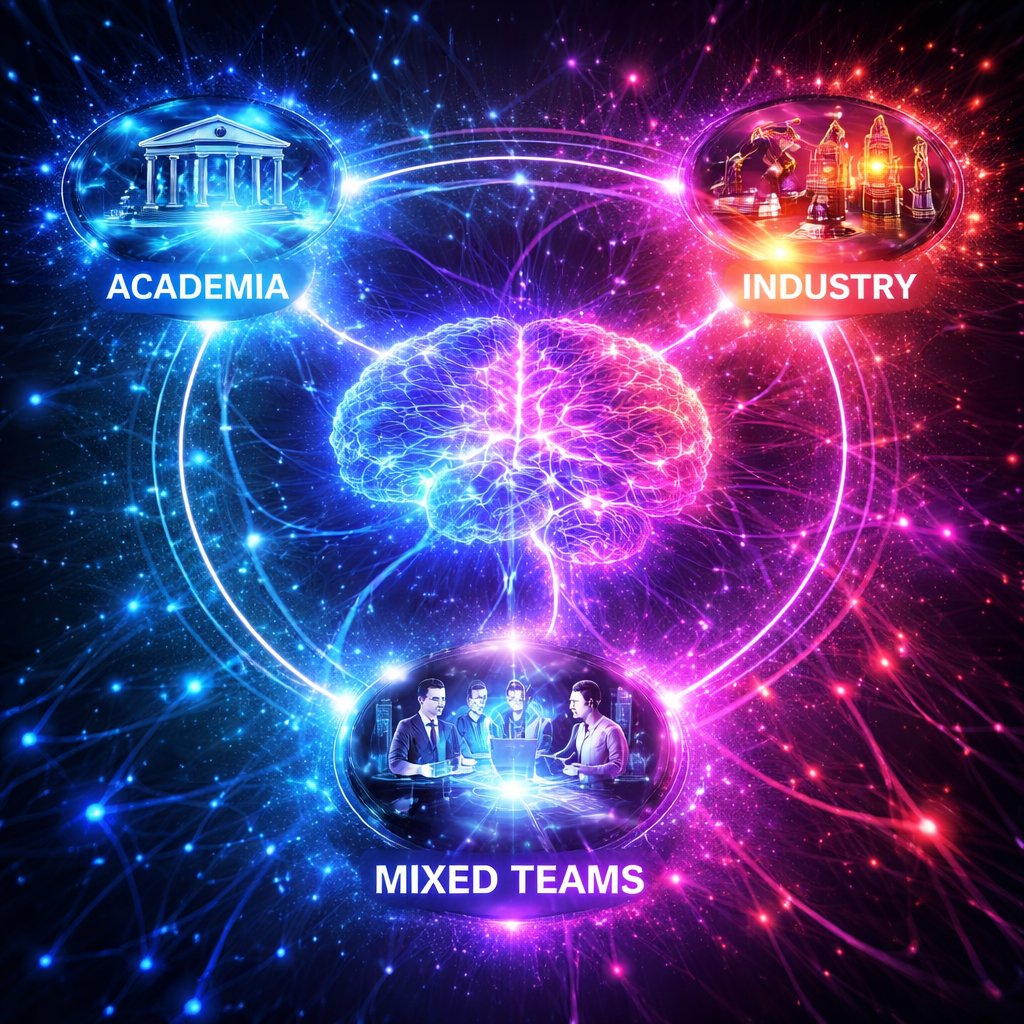
- Who’s Writing the AI Story: Academic vs Industry vs Mixed Participation
- Team Sizes and Collaboration Patterns: The Expanding yet Fragmented Network
- Subfields, Robustness, and the NCI Narrative
- Key Takeaways
- Sources & Further Reading
Introduction
If you’re curious about how a seismic shift in artificial intelligence—think large language models and the viral uptake of tools like ChatGPT—reverberates through the research world, you’re not alone. A new study dives into the AI research landscape using arXiv preprints in cs.AI from 2021 through 2025 to map who’s publishing, how teams are formed, and how academia and industry actually collaborate. The big takeaway? There was a genuine surge in AI publications after the ChatGPT era began, but cross‑sector collaboration remains surprisingly restrained when you compare it to a random baseline that would happen by chance. The findings come from a careful two‑stage data‑enrichment pipeline and an innovative use of large language models (LLMs) to classify institutions. If you want the full nerdy details, this is based on new research from the paper “Structural shifts in institutional participation and collaboration within the AI arXiv preprint research ecosystem” (link below).
For context and deeper dive, you can check the original paper here: https://arxiv.org/abs/2602.03969
Why This Matters
- What’s happening right now in AI research networks matters beyond nerdy metrics. The combination of fast‑moving generative AI tooling and a growing volume of preprints creates a real‑time laboratory for watching how teams and institutions reorganize to chase the best ideas and resources.
- Real‑world scenario: Imagine a university lab trying to decide whether to invest in a state‑of‑the‑art compute cluster or partner with an industry lab to pursue a high‑impact AI model. If you’re relying on what’s happening in the wild, this study suggests that even as papers scale up and teams get bigger, actual cross‑sector collaboration doesn’t rise as fast as you’d expect under random mixing. That has implications for research access, policy, and funding strategies.
- How it builds on prior work: This isn’t just a glance at who prints more papers; it’s a structural, ecosystem‑level look at participation and teamwork in AI, using enrichment techniques and LLM‑driven institution labeling to go beyond simple affiliation strings. It extends the science‑of‑science (meta‑research) lens to a period dominated by LLM availability and new modes of research practice.
The Scale-Up: Publication Volumes and Subfield Shifts
The study tracks arXiv cs.AI preprints across five years (2021–2025), painting a clear picture of explosive growth in AI research output and shifts in where that output comes from.
Post‑ChatGPT surge in volume
- 2021: 12,520 papers
- 2022: 14,805
- 2023: 21,847
- 2024: 33,061
- 2025: 44,832
The trend reads like a hockey stick: overall growth accelerates notably after 2022, coinciding with the public diffusion of ChatGPT and the broader generative‑AI boom. The sheer scale of the 2024–2025 acceleration underscores how quickly AI research is expanding when new tools lower barriers to experimentation and dissemination.
Subfield dynamics: NLP, ML, CV as the trio on the throne
- Across the five years, machine learning (cs.LG), natural language processing (cs.CL), and computer vision (cs.CV) dominate non‑cs.AI primary categories. In 2021–2022, ML leads; by 2023–2024, NLP gains momentum and overtakes CV, while ML remains consistently large. By 2025, these three subfields together account for the majority of non‑cs.AI AI‑adjacent work.
- This pattern matters because it shows where research energy is concentrated and suggests where cross‑sector collaboration might be most impactful—or most challenging.
The “ChatGPT effect” in practice
The authors emphasize a rapid, real‑world upshift in production and dissemination—preprints as a real‑time companion to or even a substitute for traditional peer‑reviewed venues during a fast‑moving era. The arXiv cs.AI preprint stream acts like a daily weather report for AI’s social structure, revealing timely signals of where ideas are moving and who’s moving them.Practical implication: a growing, but still uneven, knowledge ecosystem
The scale‑up raises questions about access to compute and data, institutional reach, and how new models reshape the distribution of research leadership. The original paper’s conclusions point to a landscape where volume grows rapidly, yet the governance and collaboration patterns don’t automatically democratize as the field expands.
If you want a deeper look at the data pipeline, the authors describe a two‑stage process: first, gathering and enriching arXiv metadata; second, classifying institutions with an LLM‑assisted scheme, then refining with an email‑domain pass. Their goal is to produce robust, scalable measures of academic, industry, mixed, and unknown affiliation statuses, which are the backbone for their later analyses.
Who’s Writing the AI Story: Academic vs Industry vs Mixed Participation
One of the most striking themes is the persistence of academia as the dominant engine of AI research activity, even as industry and mixed collaborations grow.
Year‑by‑year composition (raw counts)
- 2021: Academic 5,241; Industry 729; Mixed 2,528; Unknown 4,021
- 2022: Academic 6,358; Industry 822; Mixed 3,186; Unknown 4,438
- 2023: Academic 9,784; Industry 1,219; Mixed 4,623; Unknown 6,221
- 2024: Academic 15,027; Industry 1,902; Mixed 6,412; Unknown 9,720
- 2025: Academic 18,335; Industry 2,594; Mixed 7,441; Unknown 16,462
By 2025, academic papers dominate the tally, with nearly 18,400 academic‑authored works. Industry papers sit around 2,600, and mixed collaborations sit around 7,400. The number labeled unknown grows substantially in 2025 (and earlier years) as metadata completeness lags behind the expanding corpus. The researchers developed a corrective step (yearly, unknown reassignment based on manual validation) to reduce potential bias in cross‑sector counts.
Adjusted trends after unknown reassignment
After redistributing unknown papers using year‑specific empirical proportions, academic output remains the strongest growth driver, but industry and mixed collaborations also show pronounced increases:- Academic: roughly 18.6% rise 2021→2022; 55.8% 2022→2023; 44.1% 2023→2024; 33.1% 2024→2025
- Industry: 11.9% 2021→2022; 25.8% 2022→2023; 105.0% 2023→2024; 19.9% 2024→2025
- Mixed: 19.6% 2021→2022; 34.8% 2022→2023; 55.6% 2023→2024; 48.1% 2024→2025
The upshot is that, even after accounting for incomplete affiliation data, cross‑sector and industry participation grows, but not at the same pace as the total output.
What this says about access and opportunity
The findings reinforce a pattern where universities remain the main knowledge engines, while industry‑driven scaling, especially in cross‑sector contexts, is expanding but not eclipsing academic leadership. This has important implications for policy design, funding priorities, and collaborations that aim to broaden access to high‑impact AI research.Practical implication
If you’re a research administrator or funder, these dynamics suggest room for targeted programs that subsidize compute access or foster industry–university joint facilities, especially to amplify mixed collaborations in high‑stakes AI subfields.
Team Sizes and Collaboration Patterns: The Expanding yet Fragmented Network
Beyond who’s publishing, the study digs into how teams form and evolve, underscoring a paradox: bigger teams, but not proportionally more cross‑sector collaboration.
General team growth
The average number of authors per paper rises across the entire dataset:- 2021: about 4.4 authors on average
- 2025: about 5.5 authors on average
When you break it down by affiliation: - Academic‑only papers: 3.8 → 4.7 authors (modest growth)
- Industry‑only papers: 4.6 → 8.0+ authors (more substantial growth)
- Mixed academic–industry: 5.7 → ~7 authors (largest teams among the groups)
- Unknown: 4.2 → 5.4 authors (growing with the field)
These patterns show a broad shift toward larger, more coordinated teams, with industry and mixed collaborations driving the most pronounced growth in team size.
Robustness to missing data
The authors used a two‑step affiliation approach: primary LLM classification and a secondary email‑domain inference pass to recover missing signals. They also performed a reweighting step for unknown affiliations, and the overall pattern of expanding team sizes persisted after adjustment. In short: it’s not just an artifact of messy metadata—teams really are getting bigger, especially when industry is involved.The Normalized Collaboration Index (NCI)
The big star (or thorn) of the study is the NCI, which quantifies cross‑sector collaboration while accounting for team size. The key takeaway is sobering: NCI stays below 1 for every month from 2021 through 2025, typically in the 0.23–0.37 range, even as papers and teams grow. In plain terms, even as the volume and size of teams surge, actual academic–industry collaboration lags far behind what you’d expect if authors were mixing at random given team sizes.
An important caveat: December 2025 shows a bizarre near‑zero NCI (0.006) due to censored data—only 12 mixed papers out of over 3,000 papers published that month. The authors flag this anomaly and exclude the month from trend interpretation, but it’s a helpful reminder that big data streams can have fragile edge effects at the very end of a collection window.Subfield variation within the NCI story
When you slice NCI by the three main AI‑adjacent subfields (cs.LG, cs.CL, cs.HC), the suppression of cross‑sector collaboration generally holds across all three, with one subtle exception: cs.HC shows a modest, statistically detectable uptick over time, but median NCI values remain well below one. In other words, even where collaboration nudges upward, it’s still not approaching the level you’d expect if academia and industry were mixing as often as random chance would predict.Practical implication
The take‑home here is clarity: if you’re hoping to unlock faster, more diverse innovation through cross‑sector teams in AI, the data suggest this isn’t happening automatically as research scales. You’d likely need deliberate policies or programs that lower collaboration barriers, align incentives, or fund joint facilities to move NCI closer to or above the random baseline.
Subfields, Robustness, and the NCI Narrative
Understanding how these dynamics play out in different AI subareas helps translate abstract metrics into concrete implications.
Subfield snapshots
- cs.LG (machine learning): consistently large output, with sizable team sizes in mixed collaborations
- cs.CL (natural language processing): shows a faster growth trajectory and the strongest presence in post‑ChatGPT uptake
- cs.CV (computer vision): robust growth but relatively smaller cross‑sector integration compared with others
Across all three, NCI remains below 1, underscoring that cross‑sector collaboration is not simply a byproduct of scale.
Robustness checks that matter
The authors ran a robustness exercise by reclassifying unknown affiliations using year‑specific proportions from manual checks. This pushes observed mixed papers upward, nudging NCI higher (roughly from 0.23–0.37 up to 0.33–0.47 in some periods) but never above the random baseline. The qualitative conclusion holds: cross‑sector collaboration remains structurally suppressed, even under favorable reclassifications.Why this matters in practice
If you’re a researcher in industry or a university department aiming to bridge the gap, this isn’t a minor blip—it’s a structural pattern. The paper’s findings suggest that simply producing more papers or assembling bigger teams won’t automatically produce the kind of cross‑sector synergy that accelerates breakthrough AI research. Intentional, policy‑level or programmatic efforts may be essential to nudge the ecosystem toward more integrated work.
Key Takeaways
- The ChatGPT era sparked a real surge in AI preprint output in arXiv cs.AI from 2021–2025, with academia continuing to lead in volume even as industry and mixed collaborations rise.
- Despite larger teams and a growing volume of research, cross‑sector collaboration remains consistently underrepresented relative to a random‑mix baseline. The Normalized Collaboration Index (NCI) stays well below 1 across all major AI subfields, highlighting a persistent institutional divide.
- The growth in author team sizes is most pronounced for industry‑only and mixed collaborations, signaling increasing coordination costs and the complexity of coordinating multi‑partner efforts in resource‑intensive AI research.
- Subfield dynamics are uneven: NLP (cs.CL) gains emphasis and dominates growth in later years, ML (cs.LG) remains a staple, and CV (cs.CV) shows solid growth but less cross‑sector integration relative to others.
- The authors’ two‑stage enrichment pipeline—augmented by an email‑domain inference pass—provides a scalable framework for large‑scale scientometric analysis and could be a blueprint for monitoring other rapidly evolving domains.
- Practical implications: policy makers, funders, and research managers should consider targeted collaboration incentives, shared compute resources, and structured industry–academic partnerships to bridge the observed gap between productivity and integration.
For readers and practitioners, the big question is how to design mechanisms that translate scale and capability into broader, more meaningful collaboration. If the aim is to accelerate transformative AI responsibly and inclusively, this study offers a clear diagnostic: the sheer pace and scale of AI research alone aren’t enough to dissolve the institutional walls that separate academia from industry. Deliberate, well‑crafted mechanisms are needed to turn expansion into integrated progress.
Sources & Further Reading
- Original Research Paper: Structural shifts in institutional participation and collaboration within the AI arXiv preprint research ecosystem
https://arxiv.org/abs/2602.03969
- Authors: Shama Magnur, Mayank Kejriwal
Notes on the research and data provenance
- The study analyzes arXiv cs.AI preprints from 2021–2025 and enriches them with OpenAlex data, followed by a two‑stage institution classification using LLMs and email‑domain inferences to improve accuracy.
- A Normalized Collaboration Index (NCI) is used to measure cross‑sector collaboration, correcting for the confounding effect of larger team sizes on the likelihood of mixed affiliations.
- The authors acknowledge data edge effects (notably December 2025) and run robustness checks to ensure that the main conclusions do not hinge on missing data alone.
Appendix (prompt templates and methodological notes)
- The original paper’s appendix contains six prompt variants used for institution extraction and affiliation classification, highlighting the practical challenges of large‑scale LLM‑assisted annotation and the care taken to stabilize outputs for reproducibility.
If you’d like, I can tailor a version of this post for a specific audience—university administrators, policy makers, AI developers, or general readers—and adapt the emphasis to reflect the concerns most relevant to that group.